
RD-Plasma auf der GEC 2010 in Paris
The Research Department “Plasmas with Complex Interactions” enabled the participation of Dr. Tim Baloniak, Jun.-Prof. Jan Benedikt, Prof. Ralf Peter Brinkmann, Dr. Marc Böke, Prof. Uwe Czarnetzki, Dirk Ellerweg, Dr. Denis Eremin, Benedikt Niermann, Marina Prenzel, Priyadarshini Rajesekaran, Rüdiger Reuter, Cornelia Ruhrmann, Dr. Volker Schulz-von der Gathen, Dr. Ilija Stefanovic, Michael Westermeier, and Prof. Jörg Winter in the 63rd Gaseous Electronics Conference (GEC 2010) in Paris between October 4th and 8th 2010. The GEC is a yearly platform for presenting recent results in the area of low temperature plasma physics, and this year, showing in various fields contributions by the RD groups. The RD Plasma was represented with more than 40 talks or poster contributions showing particularly recent developments in the diagnostics, applications and modeling of micro-discharges.
Computational Plasma Physics at the RUB and in Copenhagen
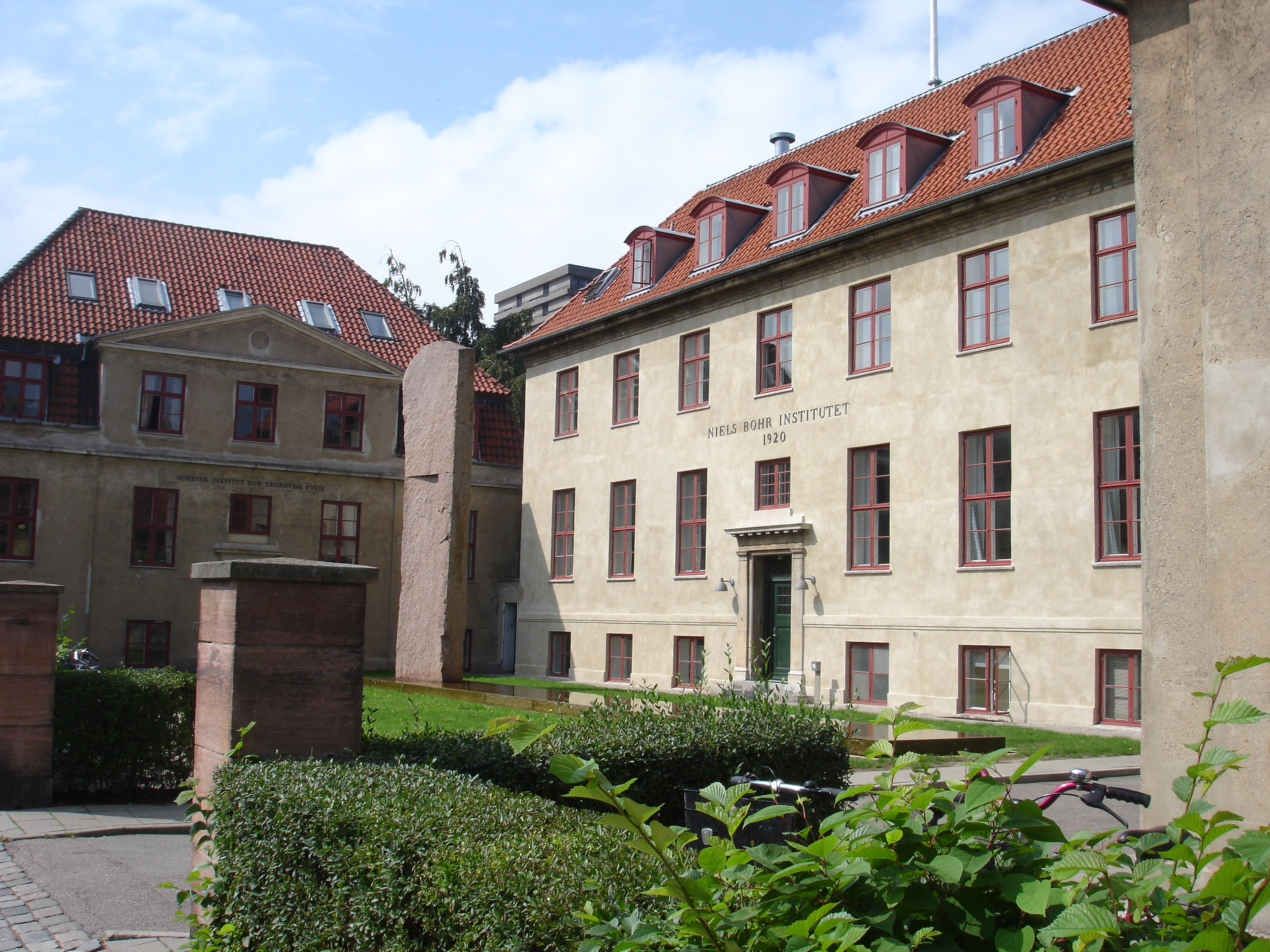
From 22.09. to 24.09.2010 an informal meeting on Computational Plasma Physics between the working group of Prof. Dr. Rainer Grauer and Prof. Dr. Åke Nordlund (Computational Astrophysics) has been held in Copenhagen at the Niels Bohr Institute. In particular, the progress of the use of graphics card clusters in this field was discussed.
On this occasion, Martin Rieke gave an introductory talk on CUDA and solving 2D EMHD equations on graphics cards. Dr. Christian Schwarz reported on his new framework cudaHYPE and its use in parallel solving of 3D MHD equations on a GPU cluster. From the Copenhagen group, Dr. Troels Haugbølle told us about his experiences with PIC (Particle in Cell) simulations on graphics cards.
In Prof. Grauer's talk, he explained strategies for coupling kinetic and fluid systems (Vlasov/MHD coupling). Last in the lecture series, Prof. Nordlund reported on new simulation results in the field of solar physics.
27.09.2010 - Dr. Sabrina Casanovas Reise zur 32. Erice School
Astrophysical shocks, for instance in supernova remnants (SNRs), are able to accelerate particles to extremely high energies. The leading acceleration mechanism is diffusive shock acceleration. Its efficiency critically depends on the injection of thermal plasma into acceleration which takes place at the subshock of the collisionless shock structure.
The magneto-hydrodynamical (MHD) turbulence confines particles to the shock front controlling their maximum energy. Therefore, the study of the MHD turbulence in a compressive plasma near a shock is a key to understanding the entire process of particle acceleration. In other words the theory of shock acceleration is a new challenge in plasma physics.
Dr. Casanova was invited by the organizers to give an overview talk at the 32nd Erice School (September 16th - 24th, 2010). She held a lecture concerning the gamma ray emission from molecular clouds close to SNRs. In the talk, Dr. Casanova presented the acceleration of particles in the shell of SNRs as well as an investigation of the the gamma ray emission produced by the accelerated particles in the shell of the SNRs and in the vicinity of the SNRs. The latter is a powerful tool to probe the properties of the acceleration mechanism, such as the maximum acceleration energy. During the time of the school, Dr. Casanova participated in the open discussions taking place every day in the early afternoon.
International Conference on Plasma Medicine (ICPM-3)
The 3rd International Conference for Plasma Medicine has been held in Greifswald, Germany from 19th -24th September, 2010. Almost 200 plasma physics researchers, medical doctors, and people from industry have met there and discussed their work on five following topics: 1) plasma surface modification for biomedical application, 2) plasma sources for medicine, 3) medical aspects and results of plasma in use, 4) plasma cell and plasma tissue interaction, and 5) plasma based sterilization/decontamination. Plasma medicine is a new and rapidly growing research field with great potentials in the applications such as in-vivo treatment of wounds and infected tissues, plasma surgery, or plasma sterilization. The Research Department "Plasmas with Complax Interactions" enabled the visit of members from research teams of Prof. Peter Awakowicz (Fac. of Electrical Engineering and Information Technology), Prof. Achim von Keudell and Jun.-Prof. Jan Benedikt (Fac. of Physics and Astronomy) and Prof. Franz Narberhaus und Jun.-Prof. Julia Bandow (Fac. of Biology and Biotechnology), which are active in this field already for several years. The visitors from RUB have presented with four talks and two posters their results of plasma sterilization with low pressure and atmospheric pressure plasmas.