
Ibrahim Sadiek honoured with Peter Werle Award
We are happy to celebrate Ibrahim Sadiek on receiving the 2026 Peter Werle Award!
The award recognizes outstanding early-career scientists whose work reflects innovation, scientific curiosity, precision, and a willingness to challenge established ideas.
Ibrahim is honored for his outstanding contributions to molecular spectroscopy, combining high-resolution laser spectroscopy, advanced spectral analysis, and modelling to explore complex and reactive molecular systems.
CRC 1316 at IWM 13 in Busan, South Korea
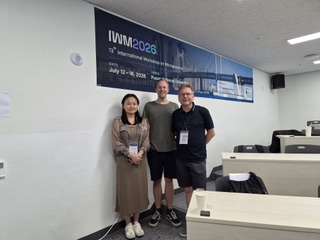 Three researchers from CRC 1316 participated in the "13th International Workshop on Microstructures (IWM 13)“, held from July 12-16 in Busan, South Korea, where they presented their latest research and exchanged ideas with leading scientists from around the world.
All three researchers contributed to the scientific program with oral presentations. Their talks covered a broad range of topics, including plasma electrolytic oxidation (Lars Schücke), catalytic conversion of n-butane (Yue Cheng), and micro-plasma arrays for gas conversion (Marc Böke).
A particular highlight of the conference was the invited talk given by Marc Böke. Participation in IWM 13 provided an excellent opportunity to strengthen international collaborations, discuss recent advances in microplasma and microstructure research, and showcase the diverse research activities of CRC 1316.
IceCube Spring Collaboration Meeting 2026 in Bochum
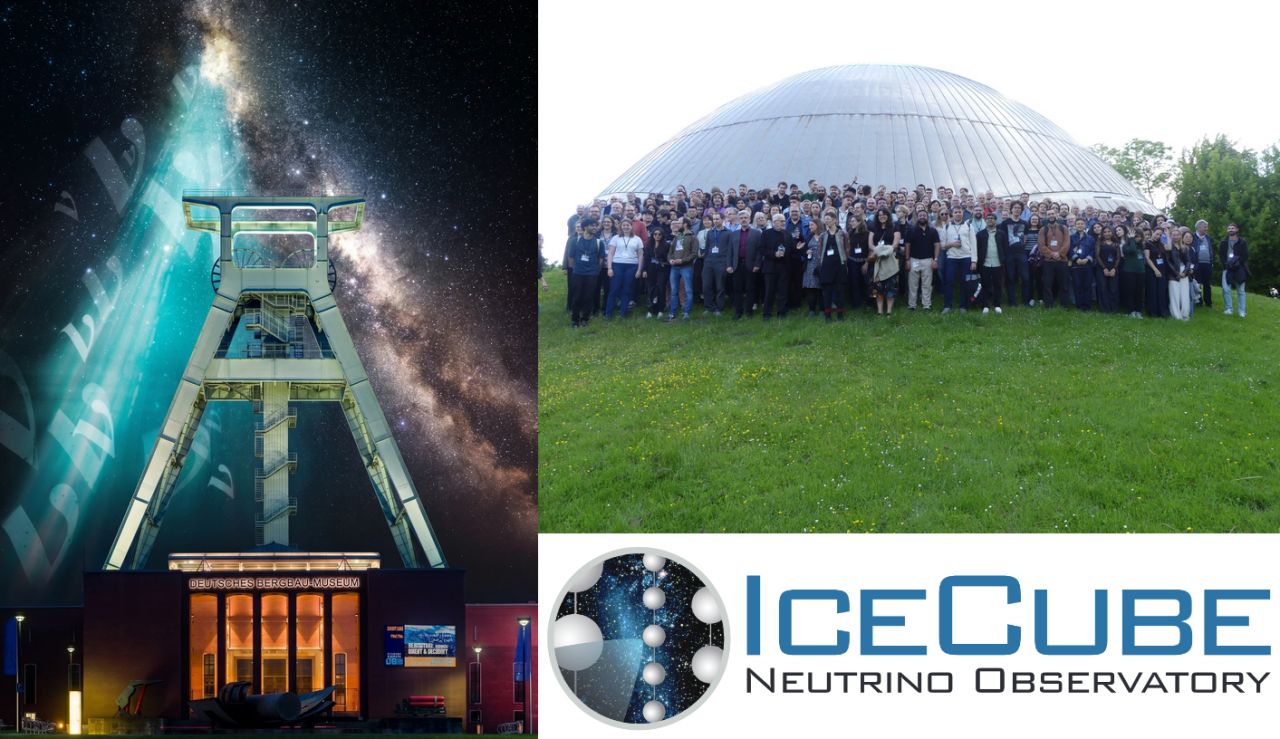 From May 18–22, the Ruhr area is hosting this year’s IceCube Spring Collaboration Meeting. Organized by SFB 1491 “Cosmic Interacting Matters”, the event brings together more than 200 scientists from around the world at the Deutsches Bergbau-Museum Bochum. The meeting provides a platform for researchers to present and discuss recent progress across the many fields represented within the IceCube Collaboration — from neutrino astronomy to astroparticle physics. The Plasma Science Hub supports this event.
International meetings like these are invaluable opportunities to strengthen collaborations, exchange ideas, and connect in person with colleagues who are often working on opposite sides of the globe.
📸 Image: Artistic impression of neutrinos pouring down on the Deutsches Bergbau-Museum Bochum Logo credit: IceCube Collaboration
SFB1491 receives funding for another four years
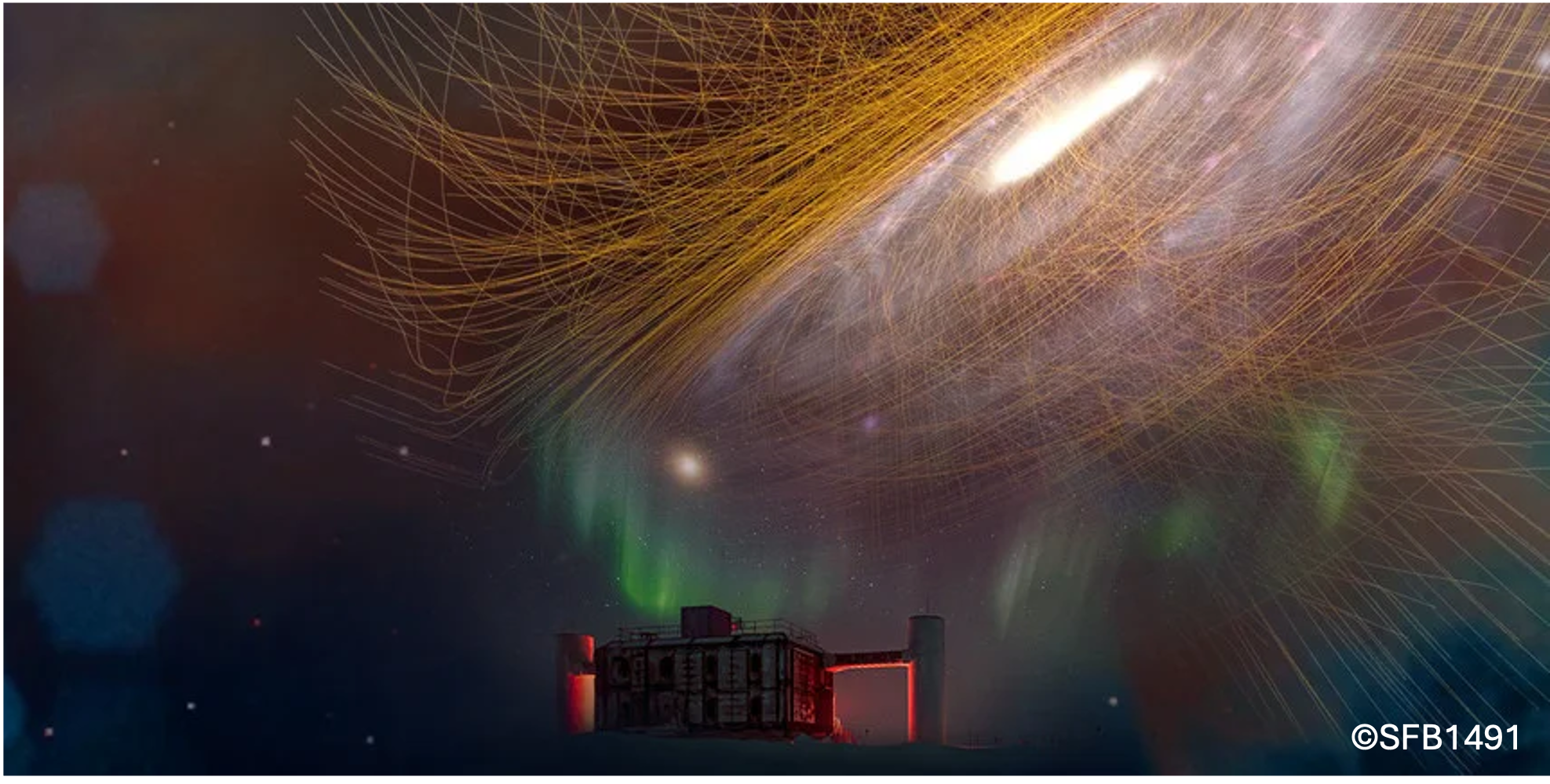 The Collaborative Research Centre 1491 “Cosmic Interacting Matter” will receive funding for another four years. The German Research Foundation has approved the continued funding of the CRC, led by spokesperson Prof. Dr. Julia Tjus at Ruhr University Bochum, from 1 July 2026. There is a lot going on in the sky: stars are born and die, charged particles, radiation and neutrinos collide and influence one another. The Collaborative Research Centre has been investigating these interactions in the Universe since 2022. The team studies previously unexplored connections between different energies and particles in space: from cosmic rays, gamma rays, and neutrinos to turbulent electromagnetic fields.
Uncovering mechanisms of origin
“While our understanding of the fundamental building blocks of matter is already well established, the specific interactions responsible for multimessenger emissions from galaxies across a broad range of energies and particle species remain an important research question,” says Julia Tjus.
By combining investigations of cosmic radiation with experiments in particle physics, the team of the Collaborative Research Centre aims to uncover the mechanisms by which high-energy particles, gamma rays and neutrinos are produced. Computer-aided modelling is also intended to illuminate the interplay between charged particles and turbulent electromagnetic fields at the plasma level.
Questions about dark matter
Since visible matter also makes up only one fifth of the Universe, understanding the nature of dark matter remains one of the greatest challenges of modern science. “Four years ago, we began working on a unified description of interacting cosmic matter and brought together scientists from the fields of particle, plasma and astrophysics to address three central scientific questions,” says Julia Tjus:
- What interactions exist between magnetized, turbulent astrophysical plasmas and cosmic radiation, and what conclusions can be drawn from them about the origin of cosmic rays?
- How do precision measurements of particle interactions help us understand the astrophysical signatures of cosmic radiation?
- What connections exist between the signatures of visible and dark matter?
In the first funding phase, global structures were developed and tested using individual examples. In the second funding phase, the focus will be on the quantification and systematization of these framework concepts. “Building on the results of the past four years, we will further expand our approach to developing methods for bridging boundaries in order to answer our fundamental questions in the coming years,” says Julia Tjus.