DPG Göttingen 2025
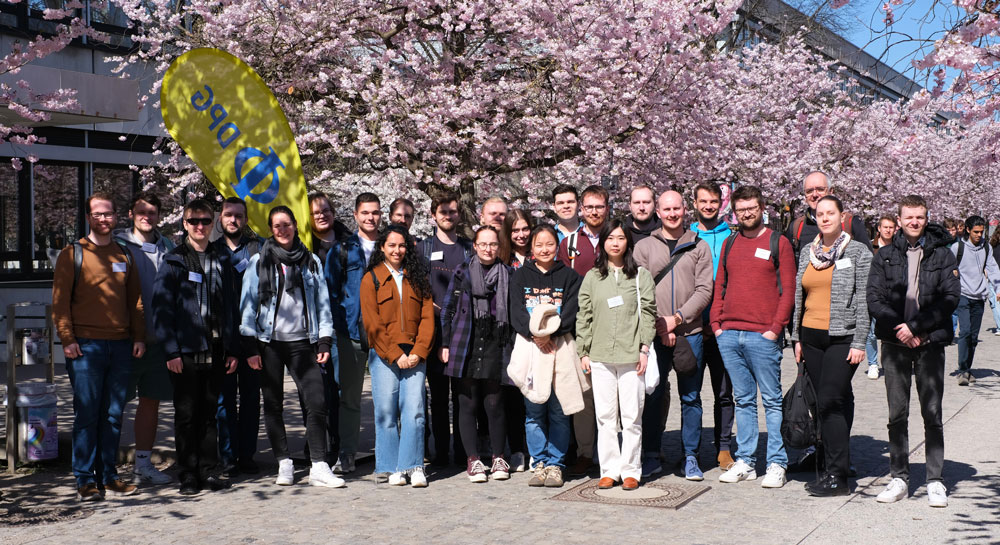
From March 31 to April 4, 2025, the spring conference of the German Physical Society (DPG), Matter and Cosmos Section, took place in Göttingen.
The SFB 1316 participated in the spring conference with three invited lectures, numerous presentations, and poster presentations. With these contributions, we not only presented the research work of the SFB 1316, but also sought to engage in active exchange with researchers in order to strengthen the network and good cooperation.
Announcement for the 4th Workshop on FAIR Data in Plasma Science
We are happy to announce the 4th Workshop on FAIR Data in Plasma Science (FDPS-IV), which will take place online and in-person on
12-13 May, 2025 at the Leibniz Institute for Plasma Science and Technology (INP) in Greifswald, Germany.
This workshop is intended to provide an overview of successful solutions for collaborative research data management with the goal to make data findable, accessible, interoperable and reusable (FAIR). It is a continuation of annual events on research data management in the low-temperature plasma (LTP) community in the past years. Open for everyone, the FDPS-IV workshop provides insights into best practice in day-to-day research work as well as infrastructure tools for handling of research data. To even broaden the discussion on future applications, a poster session will be held in-person.
Call for poster contributions
Researchers, data managers, and practitioners are invited to contribute to the discussion with a poster on their solutions on research data management. Submissions that highlight real-world experiences, best practices, and insights related to the integration of FAIR principles into research workflows are encouraged.
Registration
The workshop will be held as a hybrid meeting and participation is free of charge. Please save the date and register by following the registration link on the workshop website: https://www.plasma-mds.org/ws-fair-data-plasma-science-4.html.
Poster contributions must be submitted during the registration process. Please note that the attendance in person at INP and the number of poster spaces is limited, so early registration is encouraged to secure your spot (max. DIN A0, portrait format).
The registration will be closed on 4th May, 2025.
Contact
The workshop organization is part of the activities of the working group Experimental Plasma Physics at the Kiel University (CAU), the INF project of the CRC 1316 at the Ruhr-University Bochum (RUB) and of the department Plasma Modelling and Data Science at Leibniz Institute for Plasma Science and Technology (INP).
Dr. Markus Becker
Leibniz Institute for Plasma Science and Technology (INP)
Felix-Hausdorff-Str. 2
17489 Greifswald
Germany
E-mail:
Unconcious Bias
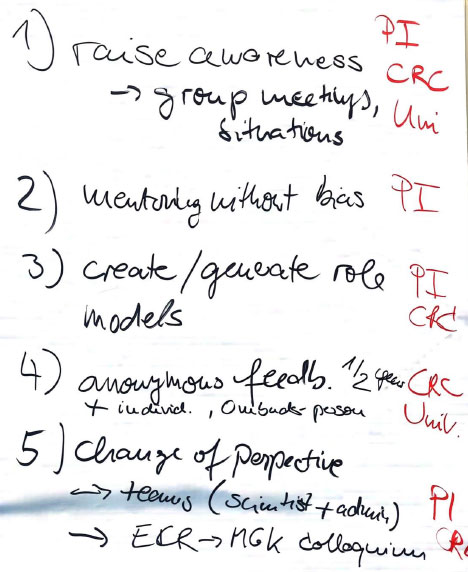 On Tuesday, March 4, 2025, members of the SFB 1316 participated in a workshop on the topic of Unconscious Bias led by Dr. Juliane Handschuh. The workshop's objective was to understand the impact of prejudices in scientific research and general work environments and learn to recognize unconscious biases in oneself and in the workplace. After Dr. Handschuh gave an introductory talk on the topic, the group was divided into groups of Early Career Researchers (ECRs) and Principal Investigators (PIs) to encourage an open exchange. In preparation for the workshop, participants had been encouraged to anonymously submit personal incidents where they experienced a bias. The group exercises were used as case studies and foundation for discussion. Together, strategies to recognize and adequately approach unconscious biases were developed as a directly affected person and as a bystander. At the end of the workshop, both groups joined again for a final discussion. The workshop provided valuable insights into the complex topic of unconscious biases and has provided the members of the SFB with practical tools to foster a more inclusive research environment.
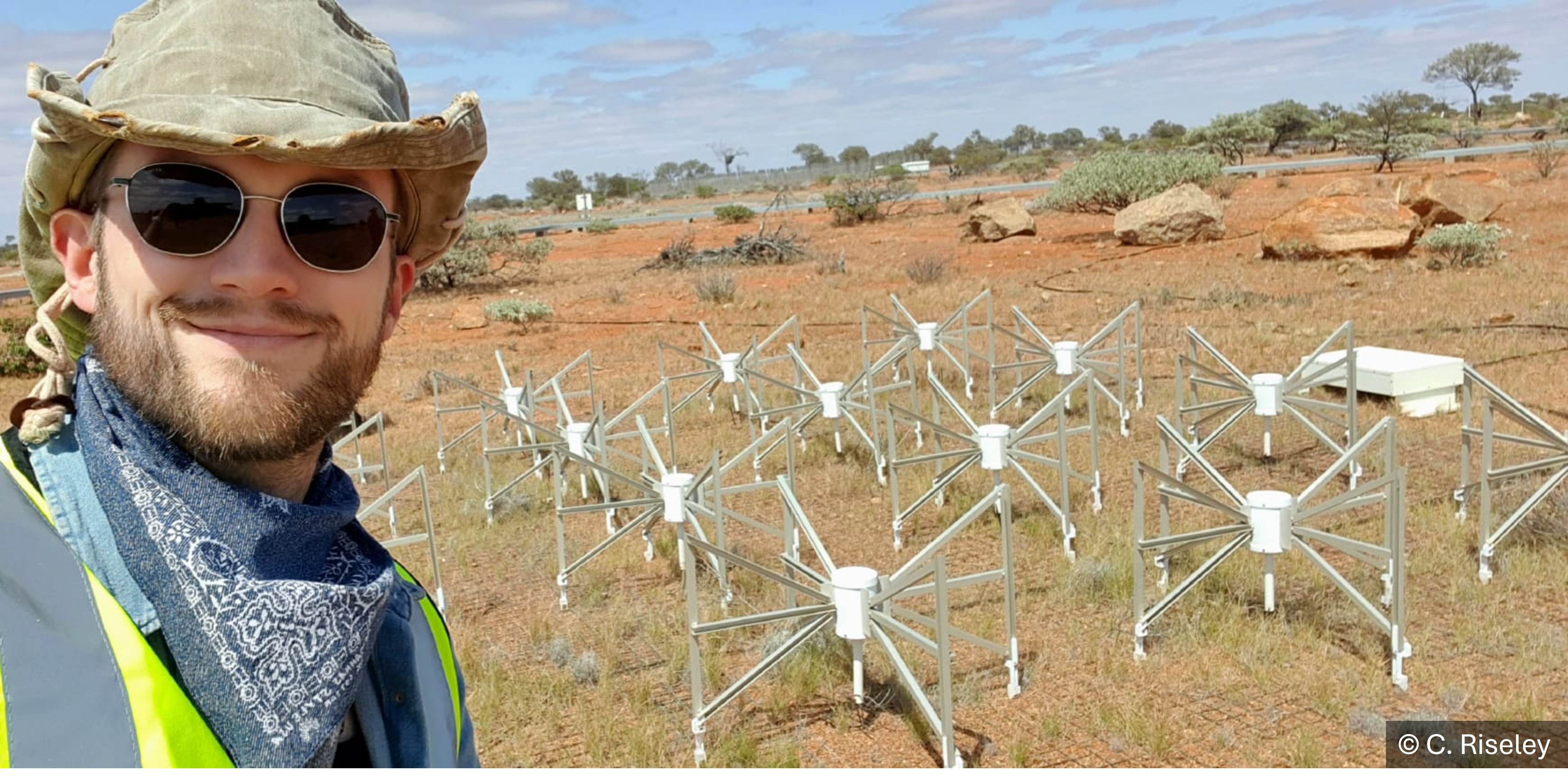
Welcome to our new PI Chris Riseley!
We are excited to announce that Dr. Christopher Riseley has been appointed as a new PI at our CRC.
Chris is a Junior Professor of Radio Astronomy at the Astronomical Institute of Ruhr-University Bochum (AIRUB). His research focuses on using radio telescopes worldwide to study clusters of galaxies. He aims to answer key scientific questions related to diffuse radio sources in galaxy clusters, including canonical relics, haloes, and mini-haloes. Chris is also exploring the unique sources discovered by the precursor instruments for the Square Kilometre Array (SKA).
Specializing in long-wavelength radio astronomy, Chris works extensively with data from the LOw-Frequency ARray (LOFAR), the Murchison Widefield Array (MWA), the Australian Square Kilometre Array Pathfinder (ASKAP), and the MeerKAT telescope in South Africa.
In the coming years Chris will use these instruments to explore galaxy groups, understanding the interplay between galaxies and their environments. Within the CRC, Chris will apply his radio astronomy expertise to studying the rich physics of dwarf galaxies and nearby galaxies in these environments, answering questions related to dark matter, Cosmic Rays, galaxy evolution, and feedback mechanisms.