
Splinter Meeting at the German Astronomical Society Annual Meeting 2025
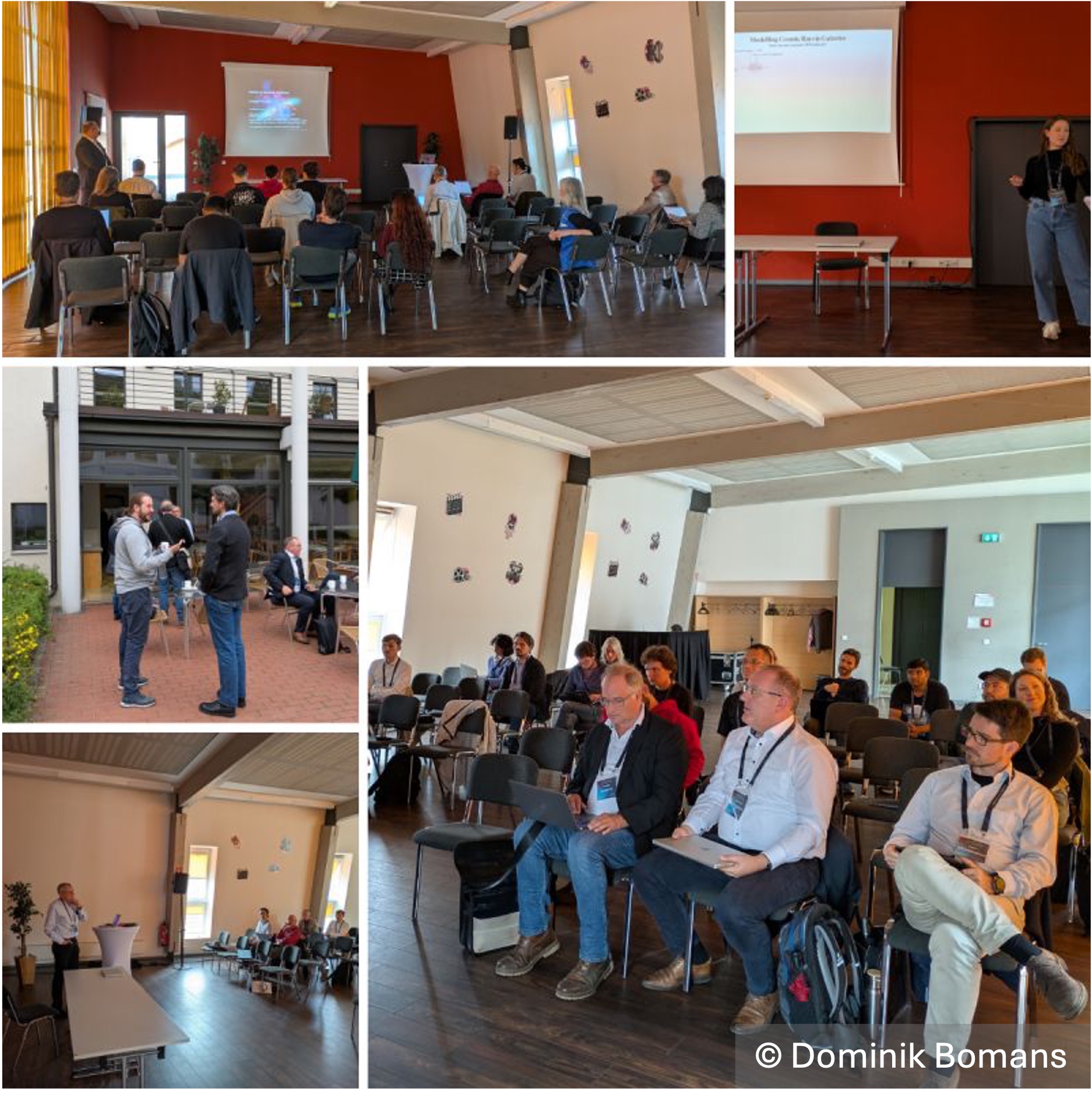 The CRC 1491 contributed to the 2025 Annual Meeting of the German Astronomical Society (Astronomische Gesellschaft) with the dedicated Splinter Session “Multi-messenger Signatures of Feedback Processes in Galaxies”, organized by Dominik Bomans and Dominik Elsässer.
This session brought together experts to discuss recent advances in understanding feedback mechanisms in galaxies through multi-messenger and multi-wavelength observations. The presentations and discussions explored how active galactic nuclei, massive stars, cosmic rays, and magnetic fields shape the interstellar medium, drive turbulence, and influence cosmic ray transport.
The full program can be found here.
Exciting News in Plasma Physics and Dark Matter Research
A recent study by the scientist Kevin Schoeffler, together with his colleagues Nitin Shukla (CINECA High-Performance Computing Department, Italy), and Luis Silva (Universidade de Lisboa, Portugal), has set a strong upper bound on long-range dark matter interactions through plasma physics. The research explores the intriguing possibility that dark matter could be charged under a unique “dark electromagnetism” (dark-EM), causing it to behave like a cold collisionless plasma.
Using advanced simulations, the team discovered that plasma instabilities could lead to significant slowdowns in dark matter dynamics.
Interestingly, astronomical observations of colliding galaxy clusters like the so-called „Bullet Cluster“ only fits to their findings if the interaction strength is extremely weak. As a result, they established a strong upper bound on the dark electromagnetic self-interaction constant.
This new constraint is much stronger than previous limits, suggesting that dark electromagnetic interactions are highly restricted.
This research not only advances our understanding of dark matter but also opens new avenues for further exploration and verification through observational measurements.
Read the full article here:
Can plasma physics establish a significant bound on long-range dark matter interactions?
K. Schoeffler N. Shukla and L. O. Silva, Phys. Rev. D 111, L071701
And please have a look at the popular science article here:
Intergalactic Collision Constrains Dark Electromagnetism
Physics 18, s48
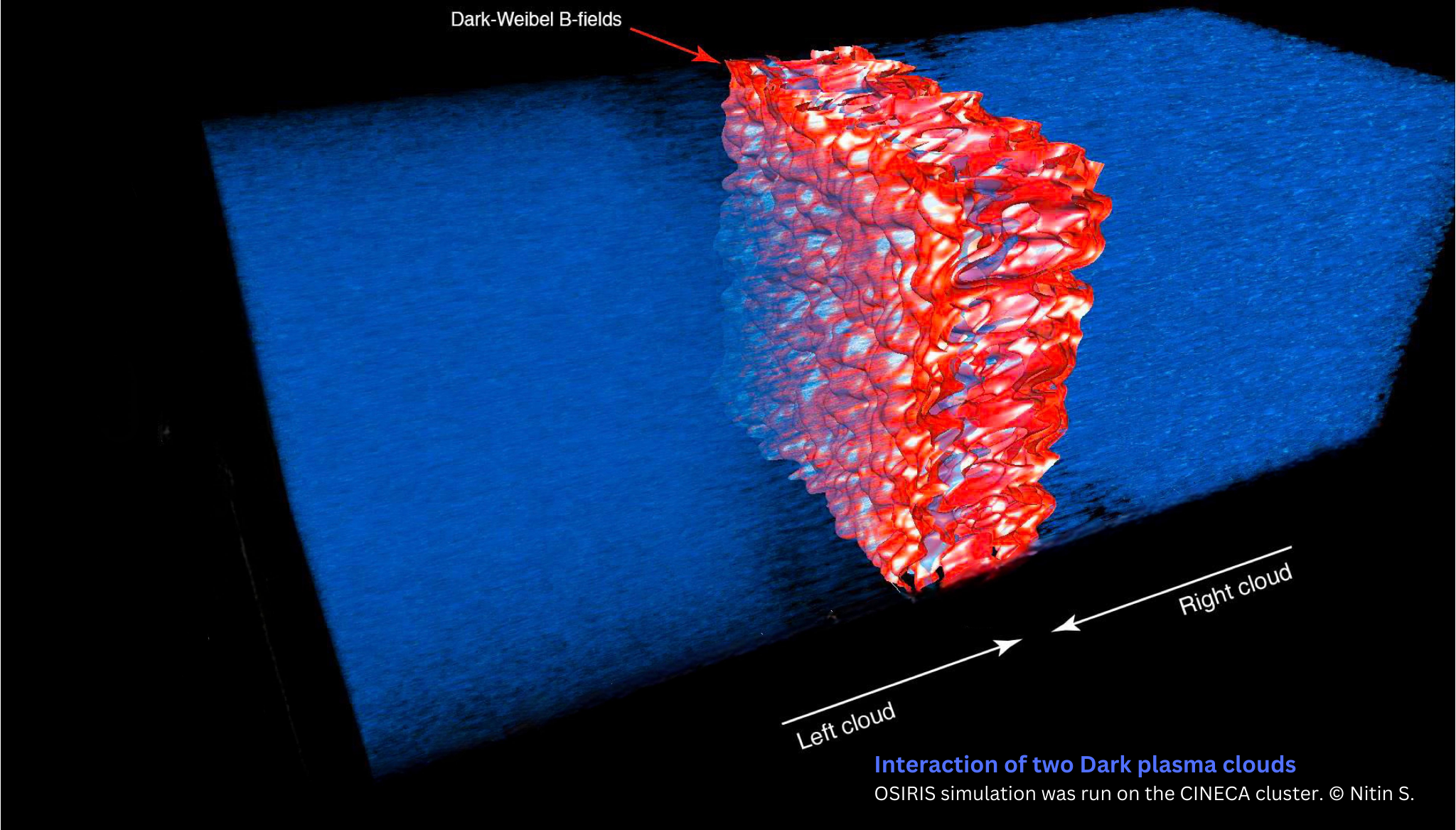
Picture: Counterstreaming slabs of dark matter plasma, shown in blue, are slowed down while interacting with dark magnetic fields, shown in red, which are generated by kinetic plasma instabilities.
Lab visit in Brazil
From Bochum to Brazil! Sarah Thiel set off on her journey and spent an exciting exchange semester at the Universidade Federal de São Carlos (UFSCar) in Brazil. Sarah is studying for a master's degree in biology at the RUB and is conducting research on enzyme immobilization in a project run by SFB1316. In Brazil, she continued working on her research project and learned new methods. But outside of research, Sarah also learned what it's like to live alone in a completely foreign country – with a new language, new people, and a completely different culture. In addition to new friendships, she brings back great impressions of everyday life in Brazil and unique experiences.
The stay took place as part of the Research School's Visiting International Professor Program, which is made possible by a cooperation between RUB and UFSCar. The research stay was funded by SFB1316.
CRC annual meeting in Hamminkeln
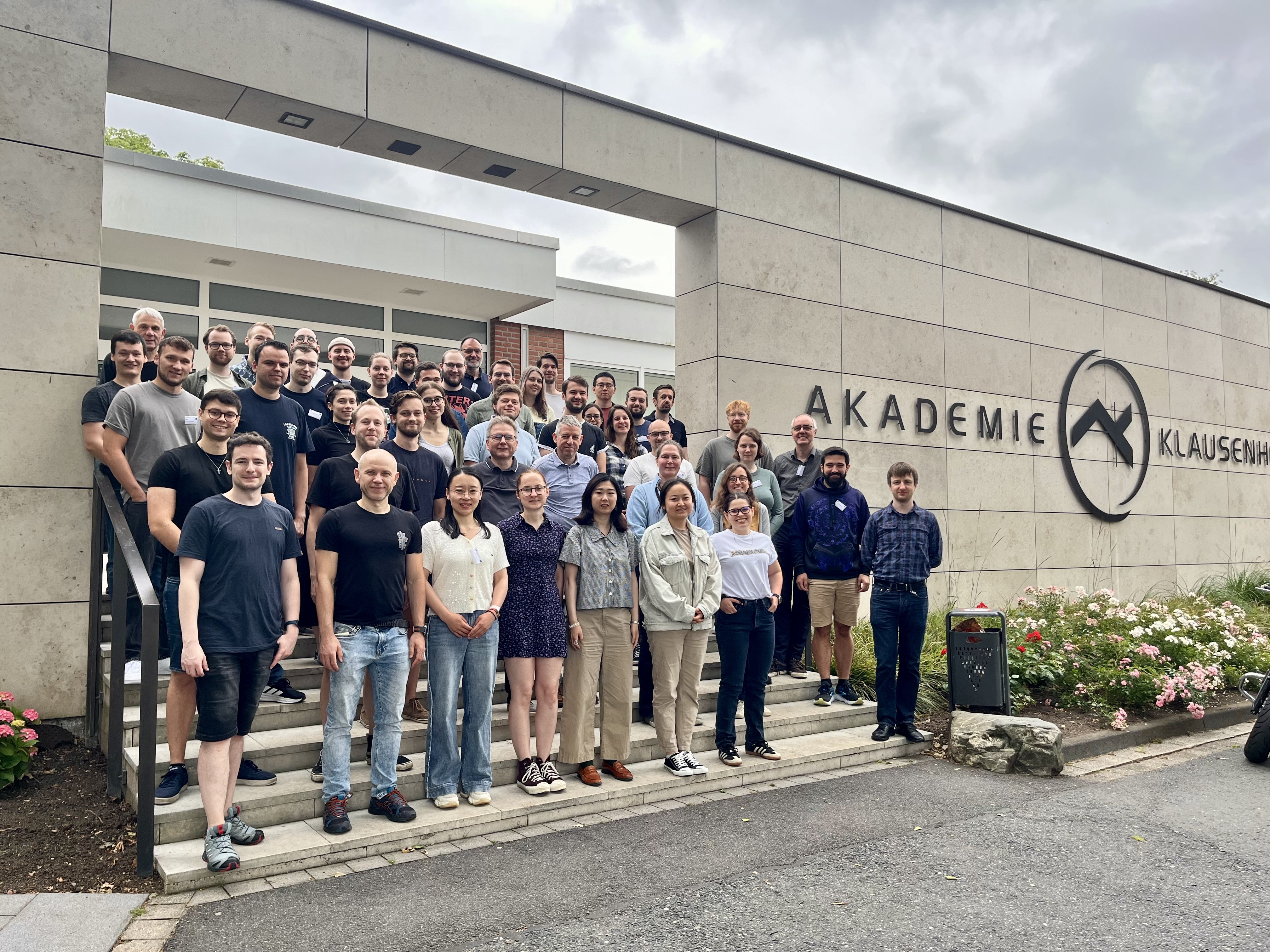 Building on the success of last year, this year’s general assembly of CRC 1316 once again took place in Hamminkeln-Dingden.
Over the course of three days, the CRC 1316 members discussed recent results and especially focussed on the upcoming scientific work.
The overwhelmingly positive feedback highlights the importance of this annual gathering in fostering scientific dialogue and advancing collaborative research.