
Junior scientists event WELTPP-18
The 18th Workshop on the Exploration of Low Temperature Plasma Physics (WELTPP-18) will be held ion December 3rd/4th, 2015 at the old convent Rolduc in Kerkrade. This workshop is intended for active scientists working in the field of low temperature plasma physics
http://www.phys.tue.nl/PMP/WELTPP/index.php
Presentations Plasma Day 2015
01a Plasma Research at AEPT (1) Peter Awakowicz (11.3 MB)
01b Plasma Research at AEPT (2) Katharina Stapelmann (2.2 MB)
02 Microplasmas Volker Schulz-von der Gathen (54.5 MB)
03 Dynamics of high power pulsed magnetron plasmas Achim von Keudell (11.7 MB)
04 Plasma Medicine at RUB Julia Bandow / Jan Benedikt (3.1 MB)
05 Plasma Physics in Galaxy Evolution Ralf-Jürgen Dettmar (19.3 MB)
06 Modeling and Simulation of Technical Plasmas Thomas Mussenbrock (15.0 MB)
07 Electromagnetic Plasma Diagnostics from DC to visible Tsanko Vaskov Tsankov (4.8 MB)
08 Heliophysics Horst Fichtner (9.3 MB)
09 Jets in Active Galactic Nuclei Dominik Elsässer (3.8 MB)
10a Flares, dynamos and turbulence: from kinetics to instantons (1) Jürgen Dreher (4.8 MB)
10b Flares, dynamos and turbulence: from kinetics to instantons (2) Rainer Grauer (4.2 MB)
11 Combinatorial Thin Film Research for the Development of New Materials Alfred Ludwig

Plasma Day 2015 Programm (6.3 MB)
PROF. JAN BENEDIKT AT SAPP CONFERENCE
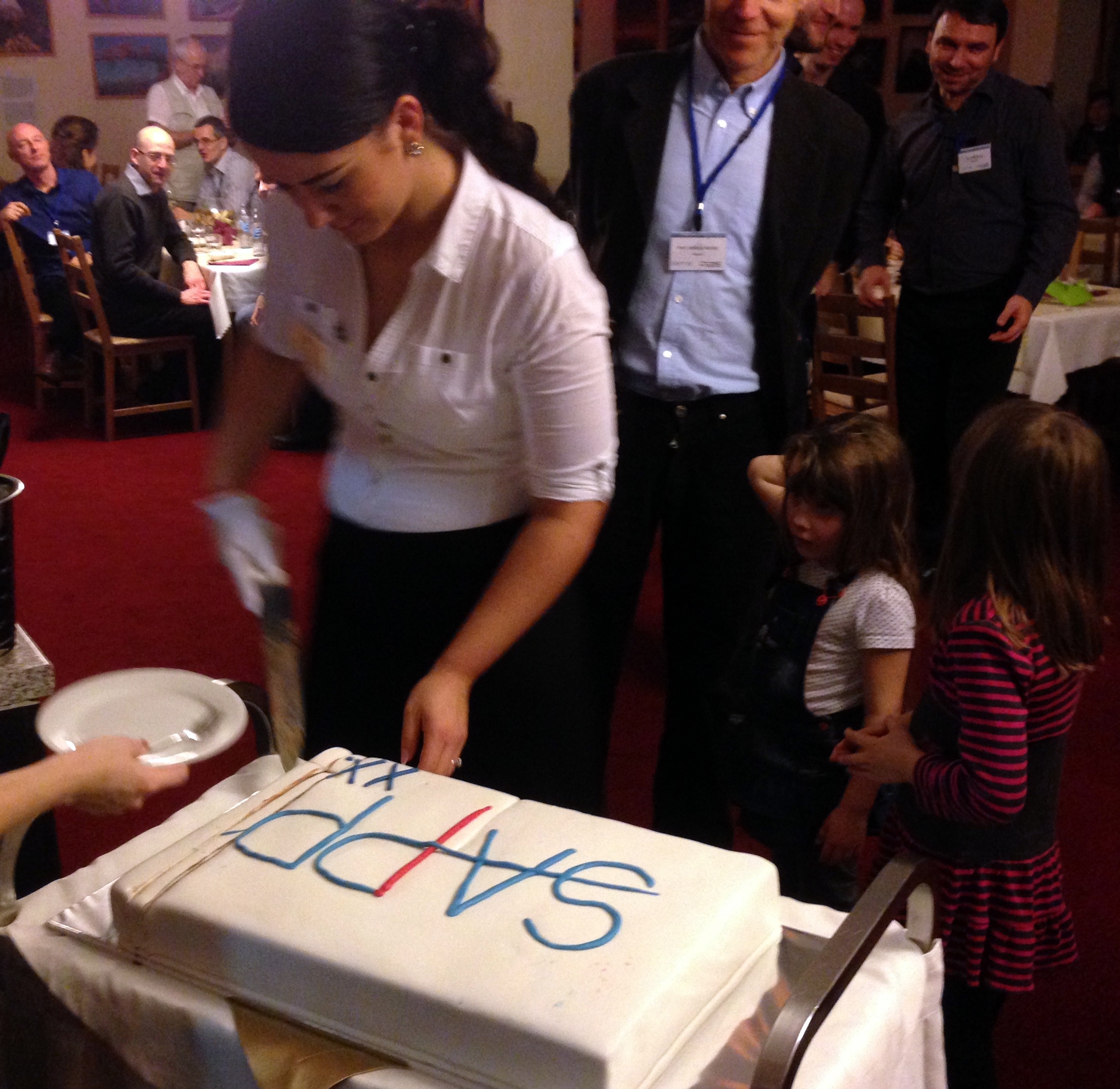
Jun.-Prof. Dr. Jan Benedikt has an invited talk “Study of plasma-chemistry processes in atmospheric plasmas: Absolute density measurements of radicals, VUV spectroscopy and some simulations” at the SAPP XX conference. This is the 20th Symposium on Applications of Plasma Processes (SAPP XX), which was this year combined with the COST TD1208 Workshop on Application of Gaseous Plasmas with Liquids. The symposium is held every two years in Slovakia and was located at Hotel SLOVAN in Taranská Lomnica, Vysoké Tatry between January 17 and January 22, 2015.
link to Conference Website
INTERNATIONAL WORKSHOP "COSMIC RAY ANISOTROPIES"
This interdisciplinary workshop will give a synoptic overview of the cosmic ray anisotropy observations by the large area telescopes as IceCube, Milagro, the Tibet airshower array among others, and those observed by spacecraft especially by the Voyager and Pamela spacecraft and the AMS instrument, as well as the theory and modeling efforts including that of the large scale heliosphere. The anisotropies in the cosmic ray flux appear from the high energy range (TeV) to low energy range (keV to MeV) that is in the propagation of galactic cosmic rays to the propagation of solar energetic particles as well as that of Jovian electrons. Recent Voyager observations also suggest that the low energy flux at the heliopause is anisotropic.
To describe the anisotropic transport a couple of models are discussed in literature. In the inner heliosphere focussed transport theories are used, which are solved numerically with the help of the equivalent stochastic differential equations. In the heliotail, for the high energy, the gyroradius is of the order of the cylindric diameter of the tail and thus one has to use the full orbit theory.
In addition all the transport models need as input the state of the local plasma enviroment. The latter is provided by large scale magnetohydrodynamic models.
Finallly, the transport of cosmic rays depends on the diffusion tensor, which is affected by the local magnetic field fluctuations and its turbulence. The acceleration or deceleration depends on the local structure of the shock fronts.
The positron anisotropy observed by Pamela spacecraft and the AMS instrument onboard of the ISS are another aspect of anomalies in the cosmic ray spectra, and some aspects shall be discussed with the emphasis on anisotropic distribution functions.
The workshop takes place at Physikzentrum Bad Honnef, 26 - 30 Januar 2015.
link to Workshop Website