
Welcome to our new PI Chris Riseley!
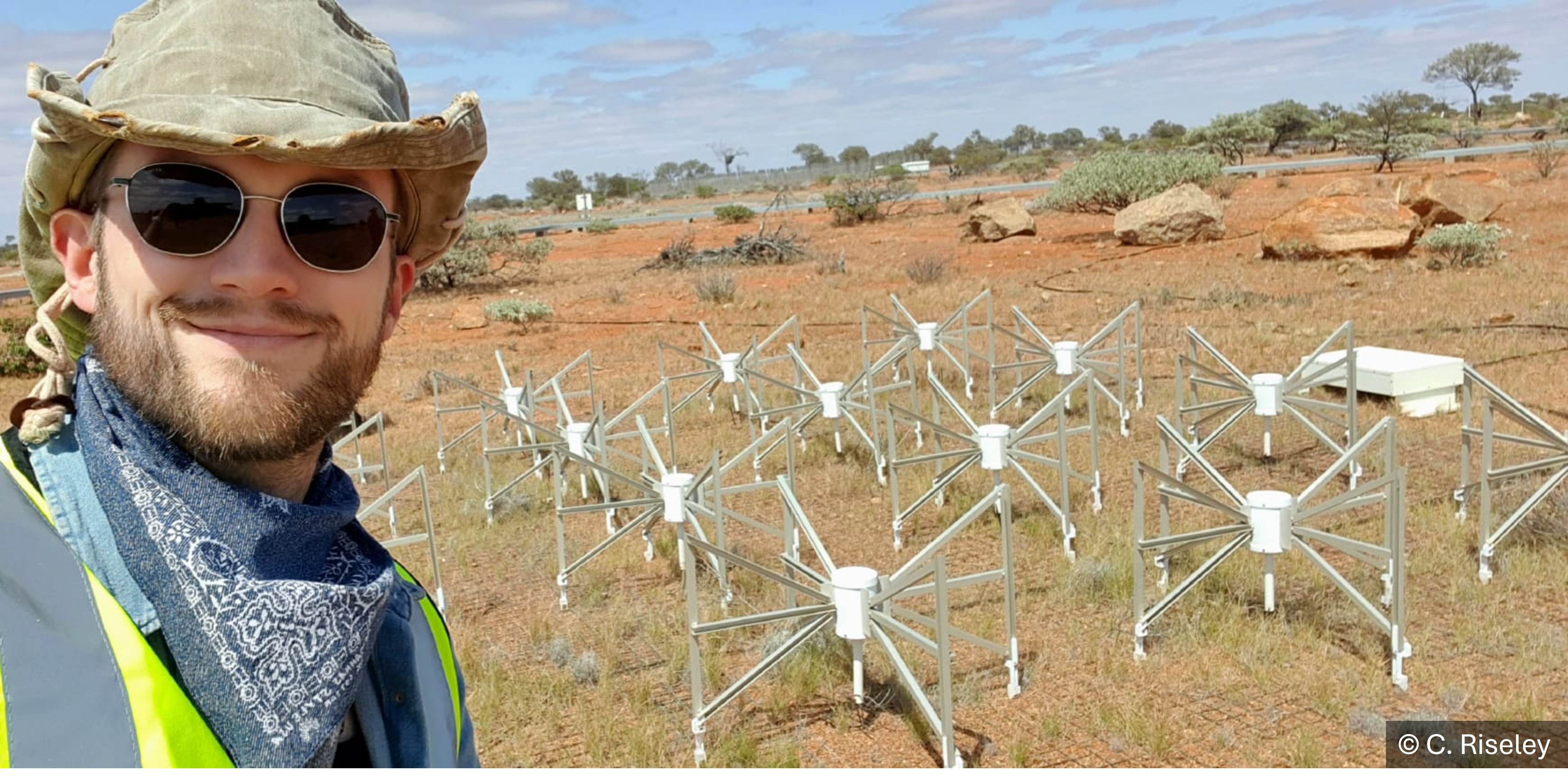
We are excited to announce that Dr. Christopher Riseley has been appointed as a new PI at our CRC.
Chris is a Junior Professor of Radio Astronomy at the Astronomical Institute of Ruhr-University Bochum (AIRUB). His research focuses on using radio telescopes worldwide to study clusters of galaxies. He aims to answer key scientific questions related to diffuse radio sources in galaxy clusters, including canonical relics, haloes, and mini-haloes. Chris is also exploring the unique sources discovered by the precursor instruments for the Square Kilometre Array (SKA).
Specializing in long-wavelength radio astronomy, Chris works extensively with data from the LOw-Frequency ARray (LOFAR), the Murchison Widefield Array (MWA), the Australian Square Kilometre Array Pathfinder (ASKAP), and the MeerKAT telescope in South Africa.
In the coming years Chris will use these instruments to explore galaxy groups, understanding the interplay between galaxies and their environments. Within the CRC, Chris will apply his radio astronomy expertise to studying the rich physics of dwarf galaxies and nearby galaxies in these environments, answering questions related to dark matter, Cosmic Rays, galaxy evolution, and feedback mechanisms.
Luminous plasmas were ignited at MINTsight.BOchum
On 18th February the MINTsight.BOchum, a study orientation day took place. High school students attended a lecture, were guided through laboratories, and could participate in exciting workshops. In our plasma workshop, students gained hands-on experience with these fascinating gases and gained insight into studying electrical engineering and physics, as well as plasma research at the Ruhr University Bochum.
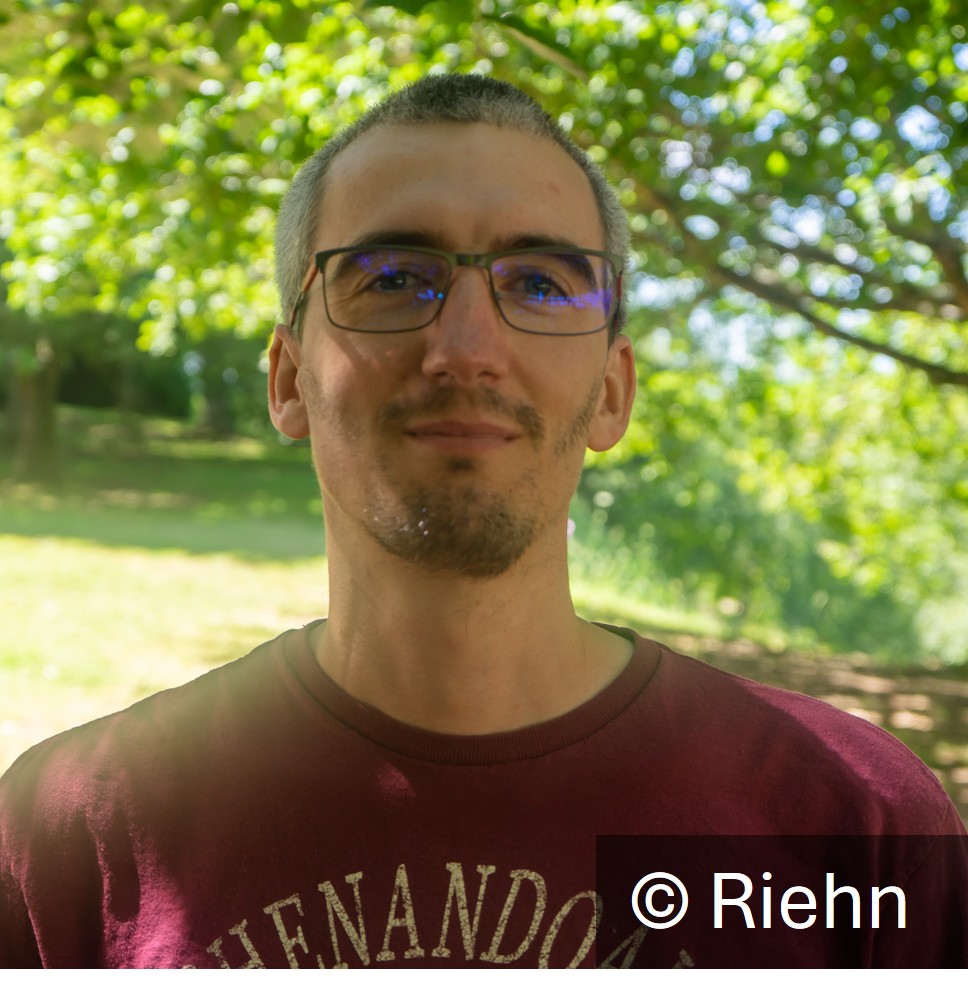
Welcome to the new PI Felix Riehn
We are happy to announce that Dr. Felix Riehn (TU Dortmund, AG Albrecht ) has joined the CRC 1491 as a new PI!
Felix studies interactions of particles at the highest energies. He mostly focuses on building theoretical models and studying extensive air showers at the Pierre Auger Observatory.
Extensive air showers are formed when ultra-high energy cosmic rays that originate somewhere outside the solar system, interact with the nuclei in the Earth's atmosphere. As it turns out, none of the models we have for particle interactions are able to describe accurately what we observe in extensive air showers. This is part of the reason why we do not know exactly where the cosmic rays were originally accelerated.
In his research within the CRC, he wants to combine cosmic ray data on particle interactions from the Auger observatory with the observations of accelerator experiments at CERN's Large Hadron Collider to improve our understanding of particle interactions.
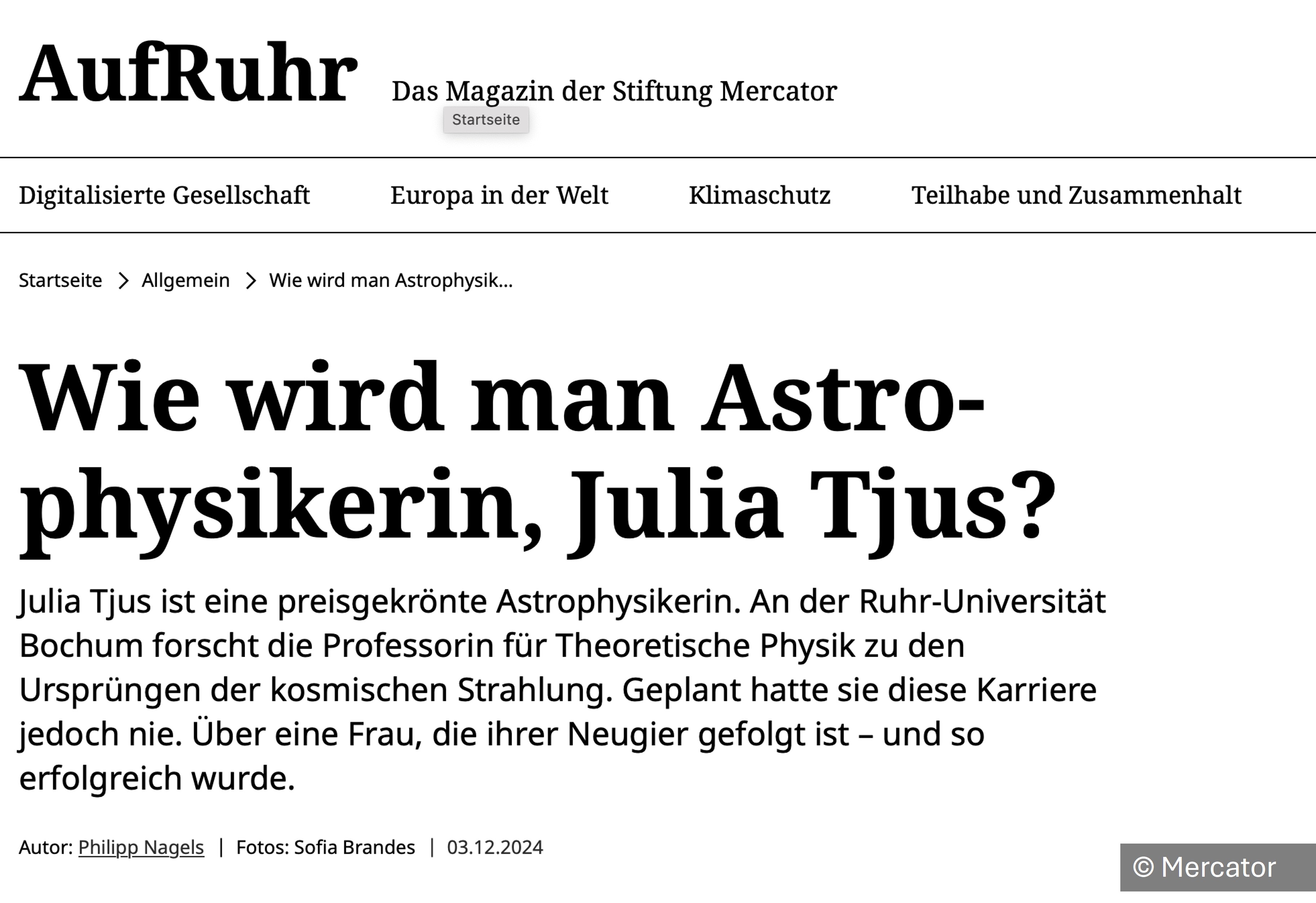
Interview with Julia Tjus in "AufRuhr"
The CRC 1491 speaker Julia Tjus was recently interviewed for the magazine “Aufruhr” by the Mercator Foundation.
She had the opportunity to talk about her research, with a particular focus on cosmic rays. Furthermore, she had the chance to share insights about her scientific career and provided helpful tips for young scientists.
The full interview (in German) can be found here.
Public lecture „Neutrinos: Unsichtbare Boten aus dem Kosmos “
We are pleased to invite you to the public lecture “Neutrinos: Unsichtbare Boten aus dem Kosmos " (in German).
Jonas Hellrung takes you on a journey to an extraordinary observatory at the South Pole, designed to detect neutrinos — ghostly particles that interact with matter only on the rarest of occasions and are therefore extremely difficult to capture. You will learn how scientists, including some from the Ruhr region, succeeded in creating the very first ‘photo’ of the Milky Way in neutrinos, and what this remarkable image reveals to us.
When 11.12.24 at 20:00
Where Planetarium Bochum
For registration and further information, please have a look at the Planetarium’s homepage.
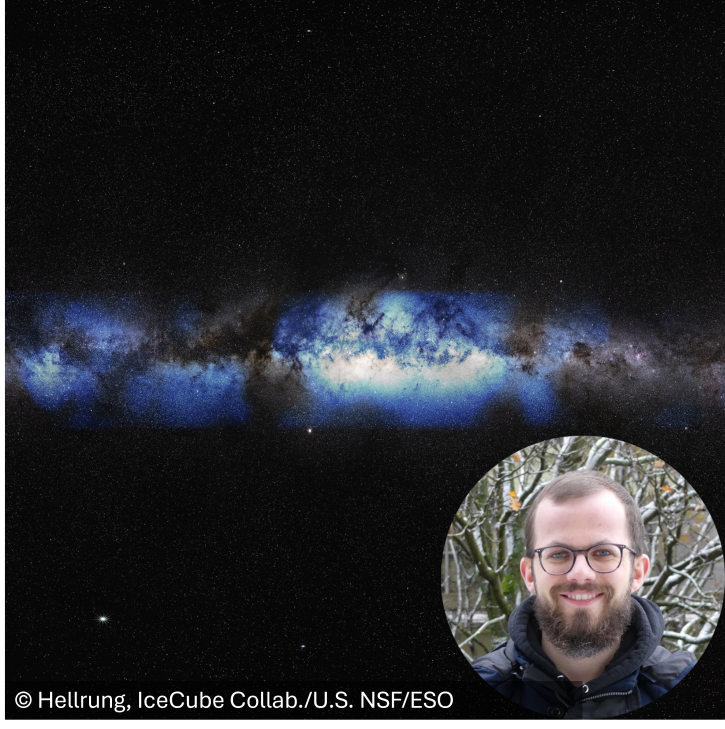
Picture:
The distribution of neutrinos (shown in blue) in the Milky Way