
TET
Dr. Maik Fröhlich zu Gast beim TET
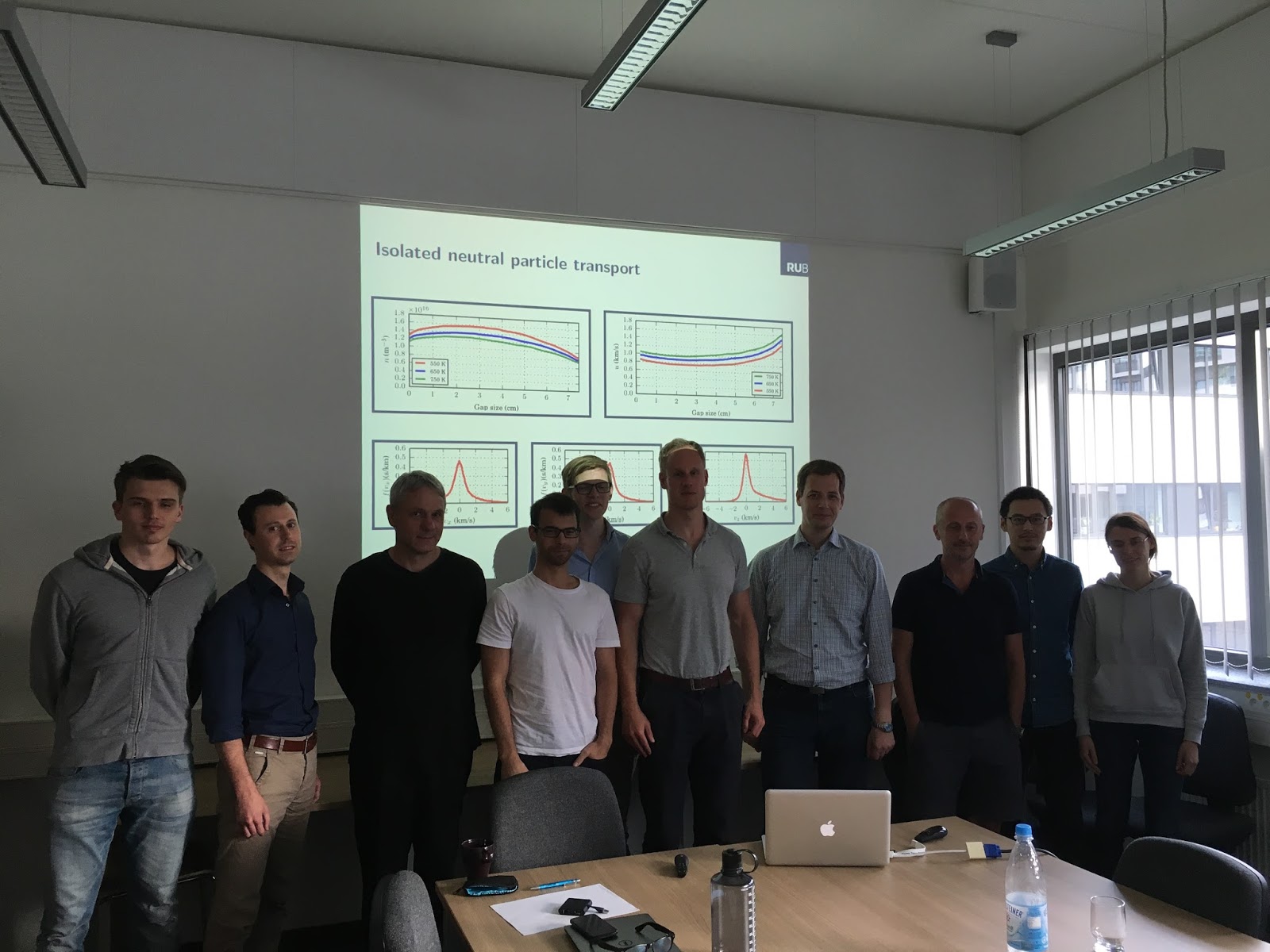 From August 8 to 9, Dr. Maik Fröhlich, head of the Plasma Surface Technology Department at the Leibniz Institute for Plasma Research and Technology e.V. (INP Greifswald), was a guest at the Chair of Theoretical Electrical Engineering at the Ruhr University Bochum as part of the IGK's Junior-Senior Program. For the purpose of scientific exchange, lectures were given and discussions were held. According to those involved, the visit and the associated discussions proved very fruitful.
EP5
PROF. DR. YI-KANG PU
From October 3 to December 17, 2016, Prof. Dr. Yi-Kang Pu from the Department of Engineering Physics, Tsinghua University, China, will join Prof. Dr. Uwe Czarnetzki, Chair of Experimental Physics V. He will give a talk on "Electron behavior in early afterglow of low pressure capacitive argon discharges" on Nov. 4 starting at 9:30 am (Room: NABF 05/694). Interested persons are welcome!
link to Yi-Kang Pu
TP4
PROF. DR. SEAN OUGHTON
From September 19 to October 14, 2016, Prof. Dr. Sean Oughton from the Department of Mathematics of The University of Waikato, New Zealand, will be a guest of PD Dr. Horst Fichtner to prepare a joint DFG project.
link to Sean Oughton
TP4
PROF. DR. YURI LITVINENKO
From December 01, 2016 to February 28, 2017, Prof. Dr. Yuri Litvinenko will again be a VIP guest of PD Dr. Horst Fichtner.
Subject: Theoretical models of cosmic-ray acceleration and transport
Abstract: The generation and transport of energetic cosmic-ray particles (electrons, protons, ions) is among the most important problems in modern astrophysics. When the particles propagate in the cosmos, they often interact with turbulent magnetic fields. The resulting complicated evolution of the cosmic-ray distribution can be mathematically described as a simpler diffusive process. The diffusion approximation and its generalisations have been employed for studying the generation and propagation of energetic particles in many astrophysical situations: in the atmosphere of the Sun, interplanetary space, and the interstellar medium.
The VIP grant will support a systematic investigation of unresolved issues of particle transport in astrophysics, with a focus on analytical and numerical modelling of diffusive particle transport. The areas of particular interest are as follows. (1) Rigorous derivation of the diffusion and telegraph approximations for cosmic-ray transport modelling, which quantifies their accuracy. (2) Development of new analytical and numerical methods for solving the equations governing the transport of solar and galactic cosmic rays. (3) Critical examination of possible mechanisms of fractional particle diffusion in the cosmos.
Foto: Copyright University of Waikato
Astronomy
Prof. Dr. Judith Irwin 
From September to November 2016, Prof. Dr. Judith Irwin from Queen's University in Kingston, Canada visited the Chair of Astronomy of Prof. Dettmar. In the context of this, she gave a colloquium lecture.
Title: Radio Circular Polarization in the Nuclei of Nearby Galaxies
Abstract: Circular polarization is technically difficult to measure in astrophysics, due to the weakness of the signal. Very few sources have had confirmed circularly polarized signals, but the scientific payoff can be significant, especially the potential insight that such observations provide on the nature of Active Galactic Nuclei.
This talk will review observations of circular polarization in nearby systems, as well as present some new results from CHANG-ES (Continuum Halos in Nearby Galaxies -- an EVLA Survey). A close look at circular polarization is especially timely now that we are approaching the era of the Square Kilometre Array.
link to Kolloquium RUB Physik
Both collaborate in the CHANG-ES project, which has the following scientific objective:
Magnetic fields are spread over the whole universe. Galaxies as well as galaxy groups and cluster exhibit magnetic fields. In Fig. 1 the magnetic field lines of an edge-on spiral galaxy is shown. In Fig. 2 the same is shown for a face-on spiral galaxy. One of the main fields of interest of modern astrophysics is to find the origin and mechanisms of the observed cosmic magnetic fields on galactic and cosmological scales.
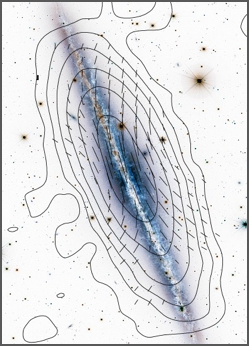
Fig. 1, Left: Edge-on spiral galaxy NGC 891 (total and polarized intensity), observed with the Effelsberg telescope at 8 GHz (3.6 cm wavelength) Optical background image: CFHT/Coelum
© M. Krause (MPIfR Bonn)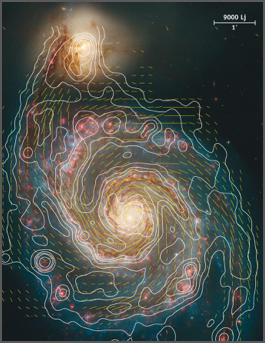
Fig. 2, Right: Spiral galaxy M51 (total and polarized intensity), combined from data observed with the interferometric radio telescope Very Large Array (VLA, USA) and the Effelsberg 100m single-dish radio telescope (Germany) at 5 GHz (6 cm wavelength), Optical background image: Hubble Space Telescope (Hubble Heritage Team)
© A. Fletcher (MPIfR Bonn)
The Galaxy survey “Continuum HAlos in Nearby Galaxies – an Evla Survey (CHANG-ES)“ was observed at the Expanded - Very Large Array (E-VLA Radiotelescope), New Mexico, USA (Fig. 3). It contains a galaxy sample of significant size over a variety of angular spatial scales, which will help to address fundamental questions regarding radio halos and magnetic fields in spiral galaxies. The PI of this Project is our VIP of the Ruhr-University Bochum Judith Irwin.
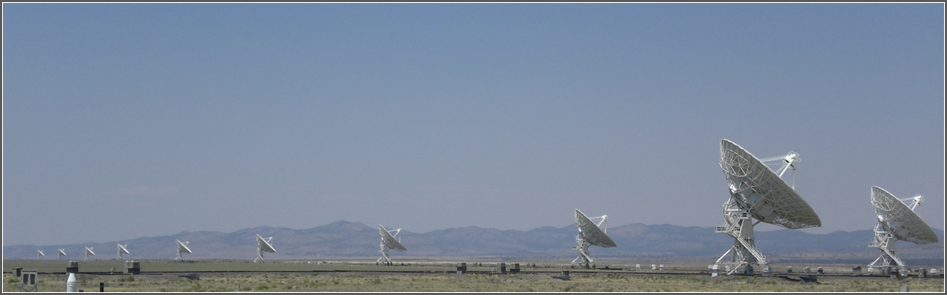
Fig. 3: Expanded - Very Large Array (E-VLA Radiotelescope), New Mexico, USA.
©Yelena Stein
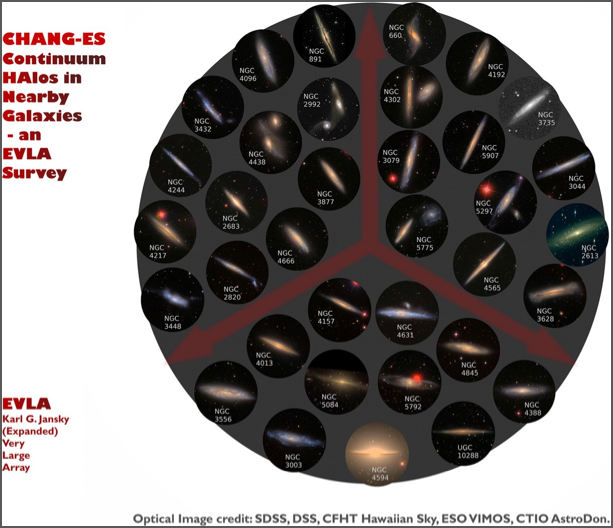
The CHANG-ES sample of 35 galaxies are all edge-on spiral galaxies with a certain luminosity and size. In Fig. 4 you see all the galaxies.
 The galaxies were observed at the two low frequencies, 1.5 GHz (20 cm wavelength) and 6 GHz (6 cm wavelength) in the radio regime to get a low contribution of thermal emission and to carry out a technique called “Faraday rotation analyses” in galaxy disks and halos. CHANG-ES can also exploit the wide bandwidths that are provided by the EVLA. These wide bandwidths permit enormous improvements in continuum sensitivity. In addition, the wide bands provide a wealth of spectral information that will be unique to this survey. Moreover, CHANG-ES is the first survey of edge-on galaxies for which all polarization products will be obtained, providing important information on halo magnetic fields (Irwin et al. 2012).
Fig. 4 CHANG-ES logo.