
18TH WORKSHOP ON THE EXPLORATION OF LOW TEMPERATURE PLASMA PHYSICS
The WELTPP-18 was held at the old convent Rolduc in Kerkrade December 3rd/4th, 2015.
The aim of this workshop is to create a forum for young low temperature plasma scientists, that is graduate students and postdoctoral researchers, to meet, learn from each other, exchange knowledge, present results and establish new contacts.
The emphasis is on the presentation of the work of the people new in this field. The scientific program consisted of 17 contributed talks, encompassing the topics fundamental processes, magnetized discharges, surface interactions, plasma chemistry and diagnostics. From our department W. Breilmann, J. Golda and G. Willems were giving talks. Additionally, an invited evening lecture by G.J.M. Hagelaar (LAPLACE) was held and there was ample time for discussions during 2 poster sessions, where B. Biskup, A. Eitrich, K. Grosse, M. Mokhtar Hefny and P. Preissig presented their posters.
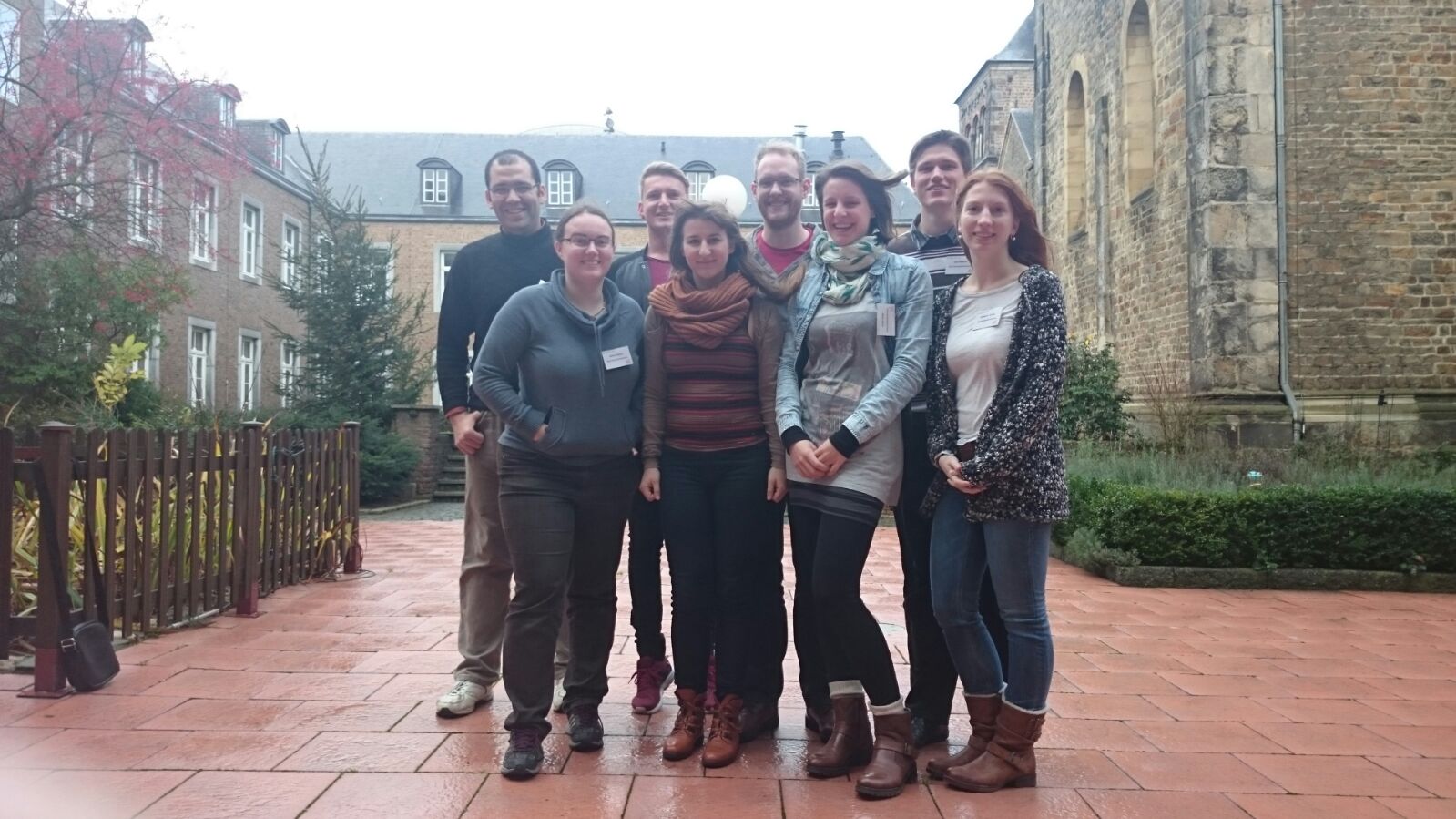
link to WELTPP 2015
27th Winter School in Theoretical Physics: Frontiers in High-Energy Astrophysics
Vom 27.12.2009 bis zum 05.01.2010 ermöglichte das Research Department Anne Stockem die Teilnahme an der "27th Winter School in Theoretical Physics: Frontiers in High-Energy Astrophysics". In Jerusalem findet einmal pro Jahr eine Winterschule mit jährlich wechselnden Themen aus der Physik statt, die durch Sponsoren wie der European Science Foundation (ESF) und des Institute for Advanced Studies (IAS) der Hebrew University ermöglicht wird. Die Schule richtete sich an Doktorandinnen und Doktoranden sowie Post-Docs aus aller Welt und bot mit Vorlesungen zur Physik von schwarzen Löchern, Vorlesungen zu rein astrophysikalischen Themen bis hin zur Physik von Schocks ein breites Spektrum.
Die gute Zusammenarbeit Israels mit den U.S.A. war spürbar. Ein Großteil der Dozenten arbeitet am Caltech oder der Harvard University. Die Vorlesungen waren auf einem hohen Niveau. Von besonderem Interesse für das Research Department waren die Vorlesungen zu Plasmainstabilitäten und Schockbeschleunigung, zum Beispiel die von Prof. Eli Waxman vom Weizmann Institute in Israel.
In den Pausen gab es Gelegenheit zum wissenschaftlichen Austausch. In diesem Rahmen wurden auch die Poster der Teilnehmer besprochen. Anne Stockem lieferte einen Beitrag mit dem Titel „Anisotropy-driven instabilities“.
Trip by Martino Olivo to the IceCube meeting in Annapolis, MD (May 2010)
IceCube is the best instrument for observing neutrinos from astrophysical plasmas. The measurement of neutrinos is essential for understanding the structure of shocked plasmas, which occur e.g. in supernova remnants, active galaxies and gamma ray bursts. Since July 2009, Jun.-Prof. Julia Becker's group and thus the Research Department "Plasmas with Complex Interactions" is a member of the IceCube collaboration. Every 6 months the members of IceCube meet to discuss the status of the experiment, new analysis techniques and the development of theoretical models for neutrino emission. The meetings are essential for the collaboration to advance the progress of IceCube and for us as a working group to take an active role in the experiment. PhD student Martino Olivo gave a talk on neutrino production in Gamma Ray Bursts at the Maryland meeting. At the collaboration meeting he was able to have discussions about the results of the Becker, Halzen, O'Murchada & Olivo, ApJ (2010) publication on neutrino emission from gamma-ray bursts with the IceCube collaboration specialists on this topic.
Julia Becker at the IceCube meeting in Berlin
IceCube is the most suitable instrument for observing neutrinos from astrophysical plasmas. The measurement of neutrinos is essential for understanding the structure of shocked plasmas that occur, for example, in supernova remnants, active galaxies, and gamma ray bursts. IceCube members meet every six months to discuss the status of the experiment, new analysis techniques, and the development of theoretical models of neutrino emission. As part of the Research Department, Jun.-Prof. Dr. Julia Becker's group participated in the meeting in Berlin (September 19-25, 2009). Here, Dr. Jens Dreyer was able to give a talk on the progress of his analysis on point source stacking and discuss both his analysis and the underlying theoretical models with other members of IceCube, including those from the USA, New Zealand, Japan, Switzerland, Sweden, Belgium, and Germany. Martino Olivo gave two talks on neutrino production in Gamma Ray Burst. A publication, also based on discussions that have been held in Berlin at the meeting, has now been submitted to "The Astrophysical Journal". For this, special discussions were held with Prof. Francis Halzen, head of the IceCube experiment. Julia Becker was Chair for the sessions on neutrino emission from Gamma Ray Bursts and was able to have further discussions on neutrino production in shocked plasmas with various members of IceCube.