
Energy Resolved Mass Spectrometer
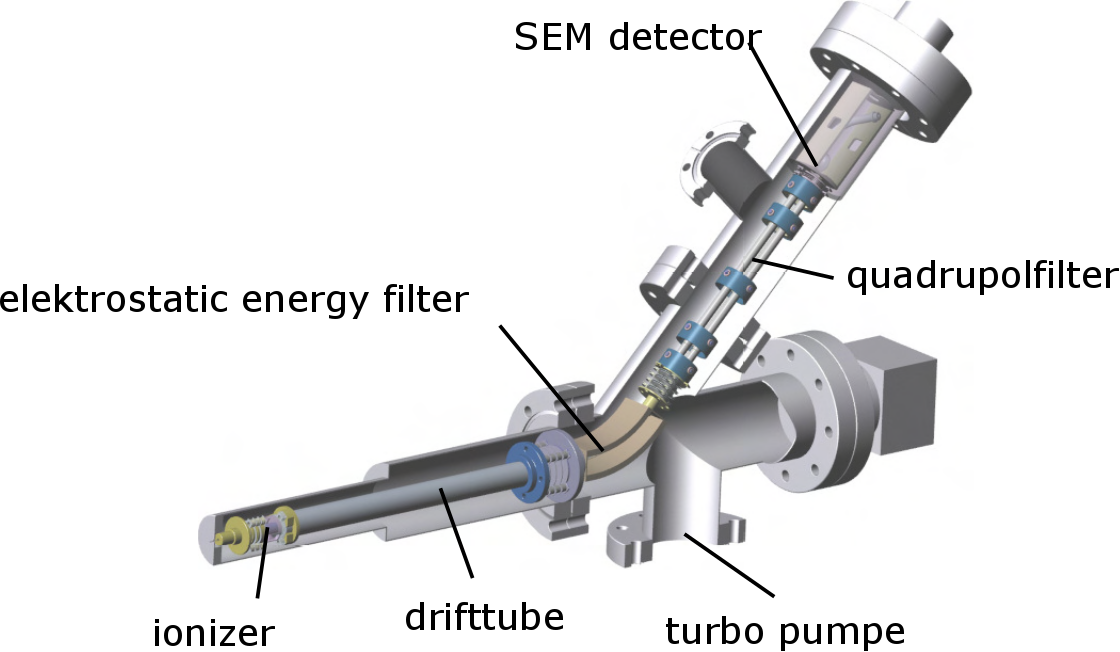
The Hiden EQP 300 HE is an energy resolved mass spectrometer which is used to measure time resolved ion energy distribution functions (IEDF) of high power pulsed magnetron sputtering (HiPIMS) discharges.
The mass spectrometer has a quadrupol filter which allows the detection of ion masses up to 300 atomic mass units (amu) with a precision of 0.01 amu. In its standard variation the energy filter, consisting of two parallel plates with a voltage apllied to, is capable of measuring the energy of ions in a range of -100 eV up to 100 eV in steps of 0.01 eV. The addition of the high energy component (HE) allows for measurements of ion energies from -1000 eV up to 1000 eV. An ionisator can be used for the detection of neutral particles.
A secondary electron multiplier is used as a detector to count ion rates. Attached to the analogue output of the detector is a transient recorder which is capable of counting events with a temporal resolution of 100 ns.
The mass spectrometer needs to be pumped separately from the vacuum chamber to which it is attached. The separate pumping reduces the amount of collisions that particles undergo in the mass spectrometer and, thus, increases the transmission of the particles.
X-ray photoelectron spectroscopy (XPS)
At the Research Department Plasmas with Complex Interactions an X-ray photoelectron spectroscopy (XPS) device is available for surface analysis. The instrument is located at the Chair for Experimental Physics II in the NB building on the RUB campus. Measurements in the context of research progress on campus are supported by the XPS instrument by providing insights into bonding states at the surface of coatings or materials. For example, this provides insight into the progression of growth behavior of coatings. In addition, depth profiling provides the opportunity to look deeper into the layer. Research on surface diagnostics is currently being carried out in CRC 1316, which will provide information on the influence of atmospheric pressure plasmas on catalysts.
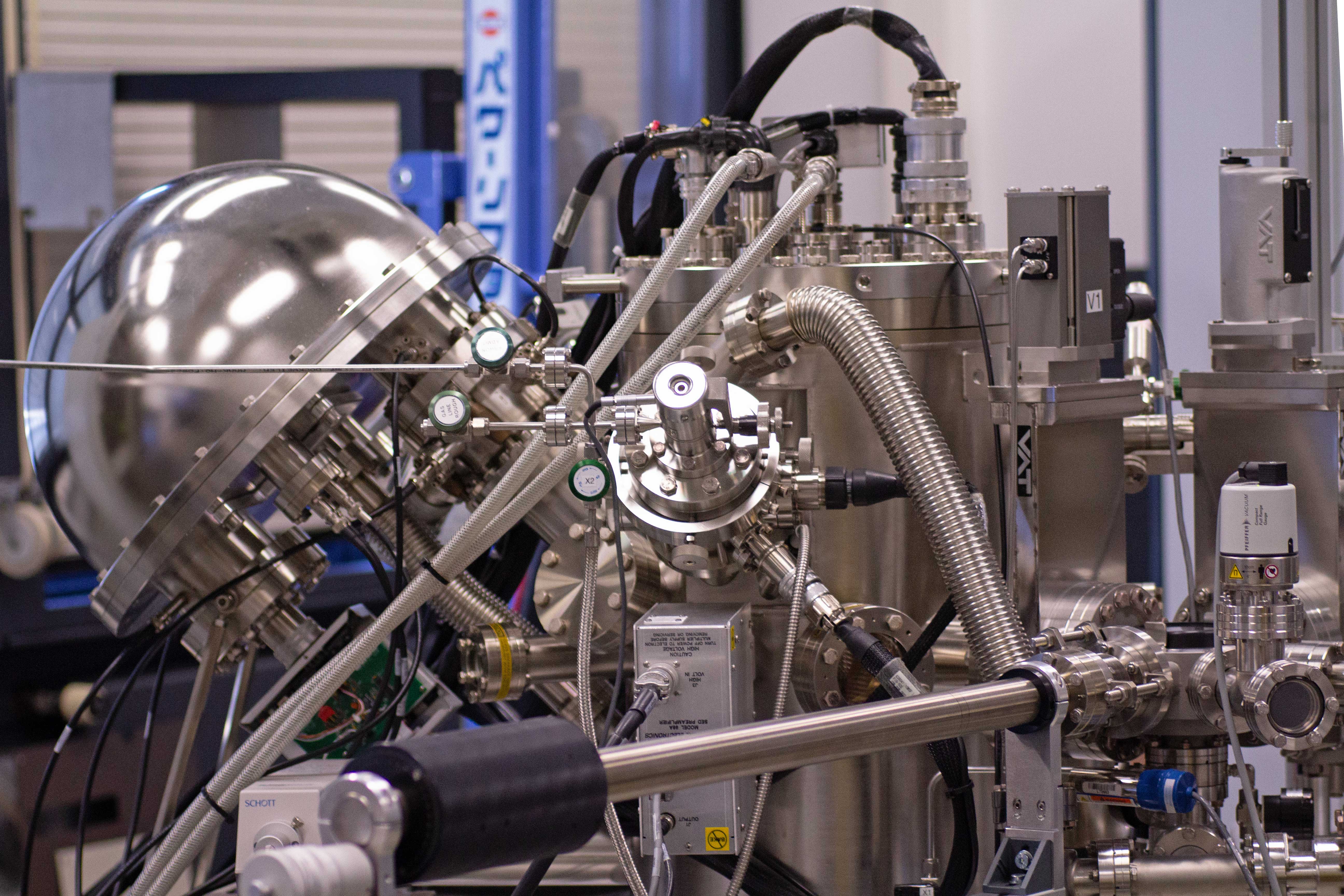
The operating principle of XPS is based on the extraction of electrons from a sample surface irradiated with X-ray photons. X-rays are generated when a beam of electrons with sufficient energy to promote transitions between atomic nuclear levels strikes an anode. The generated X-rays are directed to a monochromator where radiation with an energy of 1486.6 eV is selected. These X-ray photons are directed onto a sample. The interaction of the X-ray beam with the atoms of the sample leads to the excitation and extraction of electrons. The extracted electrons are collected in a detector where their kinetic energy is measured. Each element is characterized by the binding energies of the electrons in the different atomic nuclei levels. The only elements that are not detectable in XPS are hydrogen and helium. Chemical bonding between atoms results in a shift in the binding energy position, allowing chemical analysis of the measured samples. This technique is referred to as ESCA (Electron Spectroscopy for Chemical Analysis).
X-ray Photoelectron Spectroscopy is performed using a Versaprobe spectrometer from Physical Electronics (PHI 5000 VersaProbe). At an aluminium anode, Al K α radiation with an energy of hν = 1486.6 eV is produced. A resolution of 0.5 eV is achieved for survey spectra using a pass energy of 187.85 eV. A spectral resolution of 0.05 eV for a pass energy of 23.5 eV is usually applied for measurements of single peaks. Best resolution achieved is 0.025 eV. The measurement spot can be applied to diameters of 20 μm, 100 μm or 200 μm. Standard measurements are performed at a tilt angle of 45° between the sample and the detector. For angle resolved measurements, angles between 15° and 85° can be used. An ion gun with an argon surce is adapted so that a sputtering of the samples with energies between
20 V and 4 kV can be used.
Three kinds of sample holders are avaible, the small one is a circular 1 inch holder, the bigger one is a circular 2 inch holder. Finally, there is a angle resolved sample holder on which up to eight samples can be mounted. The circular sample holders have masks which can be installed to measure wafers or any other solid sample.
For measurement request, please register at the booking tool Calira (formerly Cluster-Market), by using the following link: XPS-booking-user-registration
Already registered users can login to the booking tool via the following link: XPS-booking
For further questions, please contact Marina Prenzel (marina.prenzel(at)rub.de)
Multi Resonance Probe/Plasma Absorption Probe
The head of the Multipole Resonance Probe (MRP) consists of two metallic hemispheres working as electrodes of a small antenna and separated by a dielectric layer. The head’s diameter is 6 mm and is enclosed by a dielectric tube (thickness of 1 mm) which is immersed in the plasma. This makes the probe insensitive against ceramic coatings which is needed in many applications. A self-developed electronic or, as an alternative, a network analyzer feeds an rf signal sweep to the antenna and displays the frequency dependence of the power absorption. This method is known as active plasma resonance spectroscopy (APRS). From the absorption spectrum the value of the electron density is calculated. In comparison to other APRS probes, the MRP shows a geometrical and electrical symmetry which significantly decreases the complexity of the model. The measurement range of the electron density is between 1013 m-3 and >1018 m-3. Time resolution lies in the range of sub ms, depending on the used electronic.
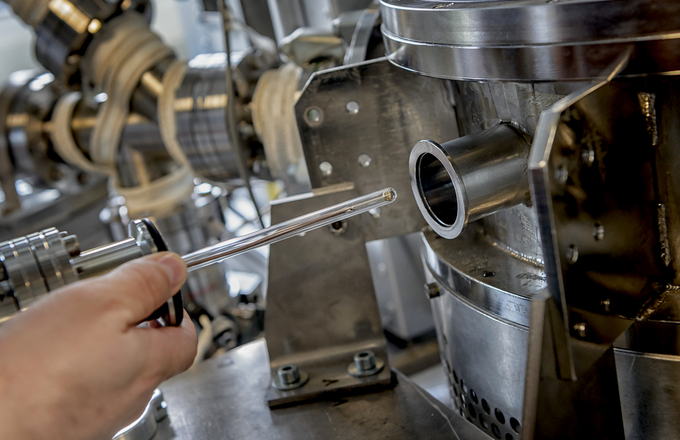
The plasma absorption probe (PAP) was invented as an economical and robust diagnostic device to determine the electron density distribution in technical plasmas. It consists of a small antenna enclosed by a dielectric tube which is immersed in the plasma. A network analyzer feeds a rf signal to the antenna and displays the frequency dependence of the power absorption. From the absorption spectrum the value of the electron density is calculated. The original evaluation formula was based on the dispersion relation of plasma surface waves propagating along an infinite dielectric cylinder. In this letter the authors present the analysis of a less idealized configuration. The calculated spectra are in good qualitative agreement with their experimental counterparts, but differ considerably from those predicted by the surface wave ansatz. An evaluation scheme which takes our findings into account will improve the performance of the PAP technique further.
The measurement range of the electron density is between 1014 m-3 and 1018 m-3. Time resolution lies in the range of sub ms.