
RUDOLF SEELIGER PREIS 2017 AN PROF. DR. JÖRG WINTER
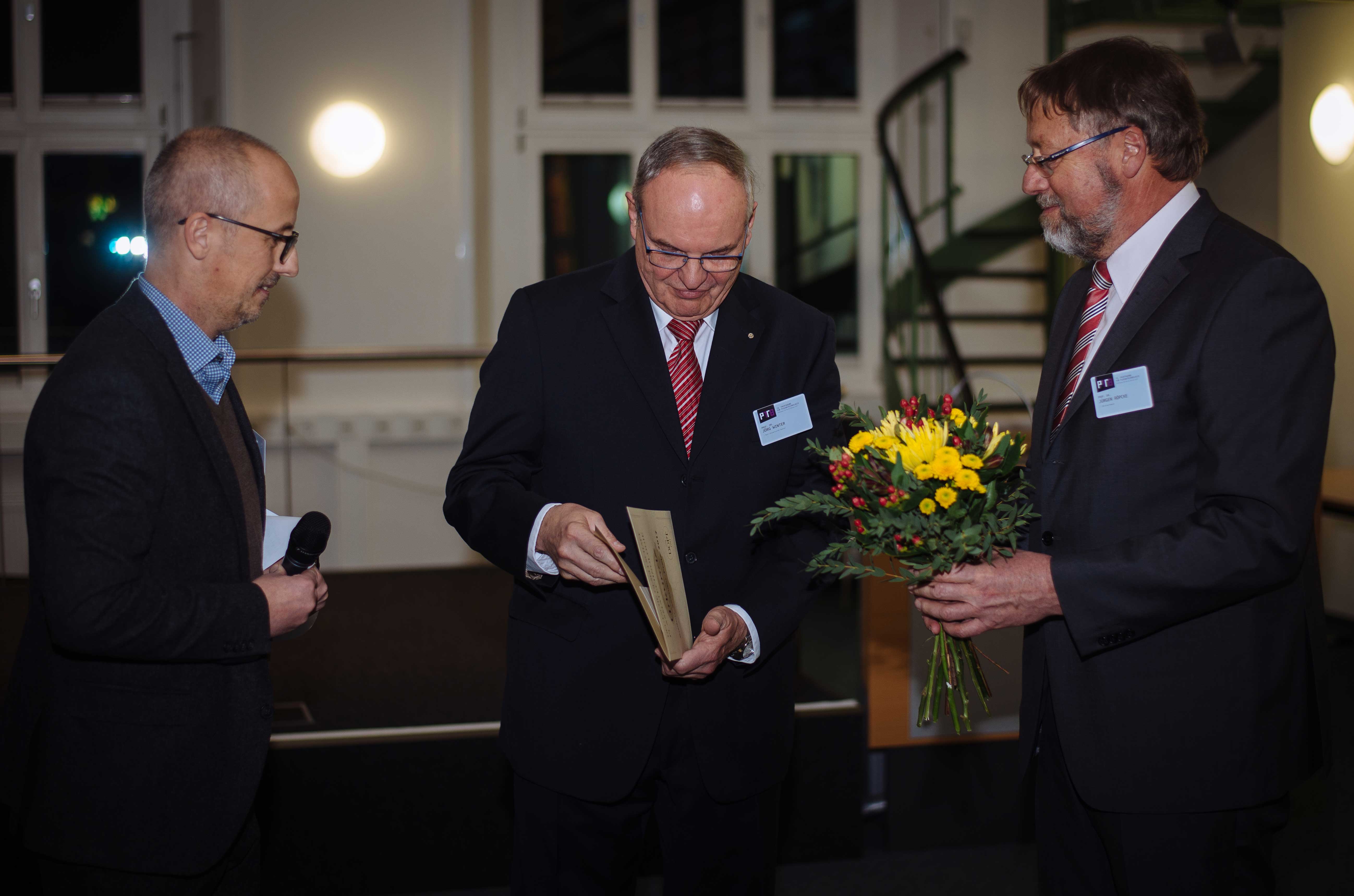 The Rudolf-Seeliger price 2017 of the German society for plasma technology was hand over to Prof. Dr. Jörg Winter during the annual conference PT18 for his scientific contribution in the field of micro plasma physics on February 22nd, 2017.
The laudation was held by Thomas Mussenbrock who honored especially his work in the field of physics of micro plasmas. Prof. Jörg Winter was a pioneer in this field who saw the potential of micro plasmas long before other scientists started to work in this field.
TP1
PROF. DR. FELIX SPANIER

On Thursday, January 9, 2014, Prof. Dr. Felix Spanier from North West University, Potchefstrom, South Africa will give a talk on "Turbulence and charged particle transport: recent advances in numerical simulations" starting at 10:15 am in NB 7/67. He is a guest of FOR 1048.
Interested parties are welcome to attend!
Abstract: The transport of high-energy charged particles in the turbulent plasmas of the heliosphere and the interstellar medium is one of the key problems in cosmic ray physics. Understanding the transport process by means of analytical calculations by the extreme complexity of the non-linear wave-particle interaction charged particles undergo.
In the past many attempt have been undertaken to perform numerical simulations of the transport of charged particles. Most of these attempt have been using artificial turbulence. I will show now our recent model combining incompressible MHD simulations with test particle transport.
I will especially focus on the problems associated with deciphering the pitch-angle diffusion from the tracks of test particles in a turbulent plasma.
TP1
DR. BRIAN LACKI
On Tuesday, January 21, 2014, Dr. Brian Lacki from Princeton University New Jersey, USA will give a talk on "Storm and Stress: Supernova-Driven Turbulence and the Chaotic Starburst ISM" starting at 10:15 am in NB 7/67.
Interested parties are welcome to attend!
Abstract: I explain my investigation into how supernovae power turbulence in the ISMs of starburst regions, and the implications for magnetic fields and cosmic rays. In weaker starbursts, supernovae blast open a hot (~40 MK) phase that escapes as a superwind. I calculate that supernovae can drive Mach ~ 1 turbulence in the hot wind. In the densest starbursts, like Arp 220, the volume is instead filled by cold molecular gas. Supernovae alone can drive turbulence in this gas to ~20 - 30 km/s, despite strong radiative losses. I predict magnetic field strengths of 70 microGauss in the Galactic Center starburst, 200 microGauss in NGC 253 and M82, and 2 milliGauss in Arp 220's nuclei. I show how supernova driving of turbulence naturally results in equipartition between several ISM phases in starbursts. I also discuss why CR diffusion may be very slow in these regions. Instead, turbulent mixing by the ISM may transport CRs, a very different process.
EP2
DR. ISABEL TANARRO
As part of the Physics Colloquium, Dr. Isabel Tanarro from Universidad Complutense de Madrid, Spain will give a talk on "Low Pressure H2 Plasmas: The Universe vs. the Lab" on January 20, 2014 (HNB, 12:15 pm). Dr. Tanarro conducts research and works at the Department of Molecular Physics of the Instituto de Estructura de la Materia, CSIC.
PD Dr. T. de los Arcos will give the introduction.
Those interested are welcome to attend!