
Girl's day 2022
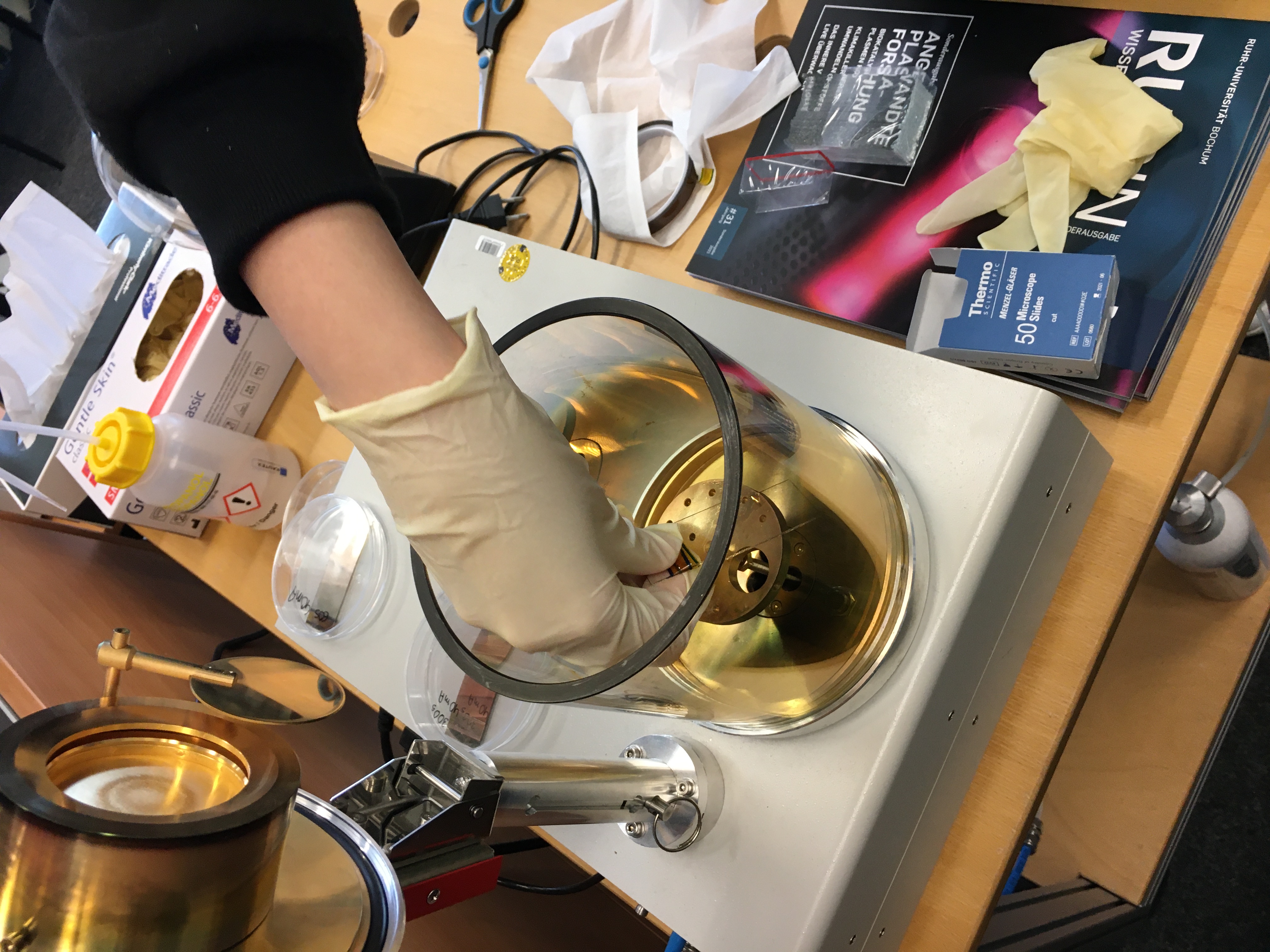
On April 28th, the annual Girls’ Day took place. Offering a 5-hour hands-on workshop on plasma physics, female students could dive into university physics as well as learn more about science, studying and career options pursuing studies in physics. During the workshop, the school students first got to know the basics of plasma – what does it consist of, how can we influence its behav- iour and which characteristics does it have. Following this rather theoretical part, the school students worked on the sputter coater, making samples to analyse with a
profilometer and identify the thickness of the surface coating from the sputtering process. The aim of the Girls’ Day is to offer female school students an insight into technical and scientific careers and motivate more school students to choose a degree in a MINT-subject. We also aim at reducing prejudices and fears towards a physics degree.
Project Week during Easter Break
During the first week of the Easter break, the project weeks for female high school students (in German Schülerinnenprojektwoche) took place and opened the doors towards plasma physics, astronomy and physics in medicine for school students grade 8 to 10.
Hosting three projects, the offer is continuously expanding after the Corona lockdown. During the project week, students attended a lecture given by PD Dr. Horst Ficht- ner on ‘news from the edge of the solar system’, visited the Planetarium in Bochum and worked on scientific projects during their workshops. The outcomes of the research projects were presented in a poster session followed by a quiz and shared lunch, which formed the conclusion of the week.
To lower the entry barrier of the project week and offer school students the chance to participate no matter of their financial status, some changes were implemented as a trial. School students who do not own a ticket for public transport had the option to receive a ticket for transportation to and from university. Also, meals were newly included in the project week. While only break- fast used to be supplied, students could now share a
free lunch in the campus dining hall, enhancing the group dynamics and their feeling of belonging in the group.
The feedback to this changes were positive according to the feedback of the participants, so that the changes will be continuously adapted to the program of the pro- ject week The project week in autumn will presumably take place with four projects at full capacity.
FOR 5409 "Structure-preserving numerical methods for volume and transition coupling of heterogeneous models" approved
The DFG has approved nine research groups for funding. To one of those, the FOR 5409, PIs Prof. Grauer and Dr. Dreher of the Research Department plasmas with complex interactions contribute.
The research group "Structure-preserving numerical methods for volume and transition coupling of heterogeneous models" conducts research on the modeling and simulation of coupled systems to describe magnetized plasmas, complex fluids, and electrochemical processes. In coupled systems, multiple processes are considered in the same region of a selected physical domain (volume coupling) or mathematical models used in different parts of a domain are combined at common boundaries (transition coupling). The goal is to develop efficient numerical methods that guarantee important structural properties of the underlying continuous models and to implement them on high-performance computers.
The chair TP I from RUB is involved with three (of nine) projects:
Project A2 (Rainer Grauer, RUB): Coupling the two-fluid/Maxwell system to Magnetohydrodynamics/Ohm's law
Project A3 (Jürgen Dreher, RUB): Adaptivity in Computational Cardiac Electrophysiology
Project B2 (Rainer Grauer, RUB and Christiane Helzel, HHU): An Active Flux Method for the Vlasov/Maxwell System
Congratulations to the PIs for this success!
CRC 1316 MGK Colloquium
With the start of the second funding period, all PhD students of the projects within the CRC 1316 were invited to participate in the annually MGK colloquium. The colloquium was held online at 7th and 8th of March 2022 and was organized by Maximilian Klich (project A8) and David Schulenberg (project A4).
The colloquium served as an introduction of the many new PhDs joining the CRC 1316 in its second funding period. Without the participation of project leaders it achieved a casual atmosphere for sharing scientific knowledge and interests between the PhD students. Here, they could introduce themselves and their pro- jects as well as give a short summary about their pro- jects achievements and future plans through talks or a poster presentation. Leading the talks regarding the different research topics modelling, DBD/RF discharg- es and plasma in liquids were the invited speakers which generated a well rounded experience.
The new funding period also required a few elections, namely the position of the PhD speaker formerly held by Maximilian Klich, as well as a position in the CRC 1316 gender board held by Lars Schücke (project A7) and Katharina Grosse (project B7). The newly elect- ed PhD speaker is David Schulenberg and Stefanie Bo- genrieder (project B4) as well as Lukas Forschner (project B12) are the new gender board representative.