
RUB Japan Science Days
From July 4 - 7 2018, top researchers, presidents, vice presidents and executives from university management and administration from the University of Tokyo, Osaka University, the University of Tsukuba and RUB meet to promote the fruitful exchange among them.
The RUB Japan Science Days will be each devoted to a guiding topic of high societal relevance that offers multi- and transdisciplinary approaches to teaching, research and transfer. This year - honoring a topic that is presently hotly debated in Japan and also in Germany - the Science Days are devoted to "Society 5.0 - Chances and Risks of Digital Transformation and the Responsibility of Universities".
Furthermore, a framework program from the RUB is aocated for the Japanese guests to learn more about science in Bochum and the Ruhr area in general.
A separate workshop with plasma scientists from Japan and Bochum finally resultet in a great exchange of both groups and new enrolled cooperations between different groups.

WissensNacht Ruhr 2018
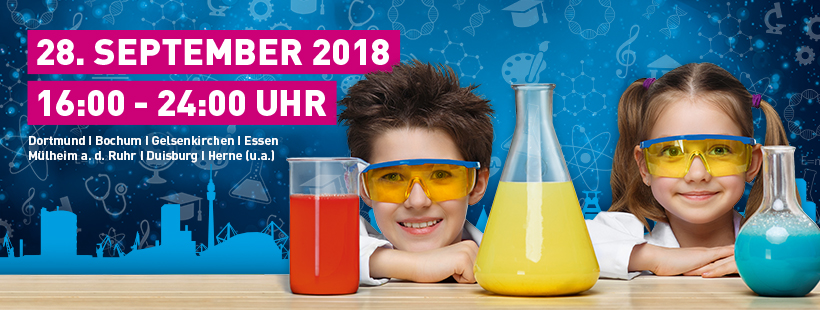
At 29th September 2018, the event WissensNacht Ruhr, which is located at seven different locations within the Ruhr Area takes place. We are going to present plasmas in the Blue Sqaure in Bochum. Everybody is welcome to join our exhibition.
SFB-TR 87 approved for third funding phase
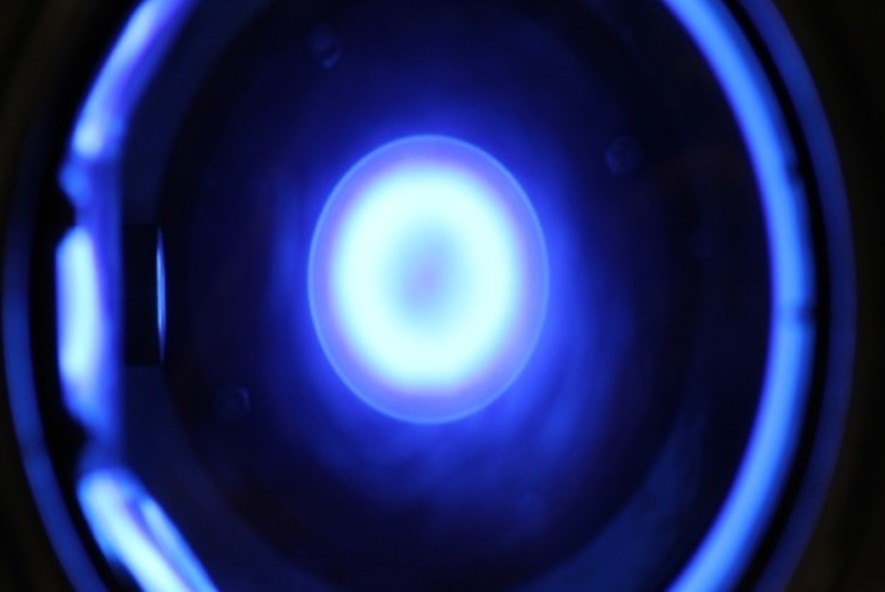
The German Research Foundation approved the proposal of Prof. Peter Awakowicz from the Electrical Engineering Departement and his consortium concerning the funding of a collaborative research project with the title " Pulsed high power plasmas for the synthesis of nanostructured functional layers". Within the consortium, 20 research projects on different topics are addressed. Especially, two transfer projects with industrial partners is also approved. The funding period is from July 2018 until June 2022.
- For more information see SFB-TR 87.
Three Collaborative Research Centers enter the third funding phase
Collaborative Research Center/Transregio 87 "Pulsed high-power plasmas for the synthesis of nanostructured functional layers".
The path to new materials on the surface of classic materials, for example for electromobility, energy technology - for solar cells, for example - but also medical technology, for example for packaging and sterilization, leads via plasma technology. Researchers from plasma technology, plasma physics, materials science and interfacial chemistry work together in the Collaborative Research Center/Transregio 87 "Pulsed High-Power Plasmas for the Synthesis of Nanostructured Functional Layers".
The subject matter includes, for example, ceramic layer systems on metal substrates and silicon or carbon-containing oxide layers on plastic substrates. "For this purpose, we use the latest source technology, some of which we have developed ourselves, and investigate the resulting layers with a broad spectrum of plasma diagnostics, some of which have also been newly developed, and unique single-particle beam experiments," explains spokesman Prof. Dr. Peter Awakowicz.
The research focuses on pulsed high-power plasmas. The aim is to explore and quantify the relationships between material properties and plasma parameters and to use them for plasma control, layer development and coating control. In this way, the researchers aim to overcome the empirical approach that has predominated to date and develop a physically and chemically based understanding of the process.
In the coming funding phase, the participants intend to make the knowledge and methods gained so far available to other coating processes, reactor systems, surface and material systems, and computer codes.
adapted from Meike Drießen (RUB)