
TET
Dr. Maik Fröhlich zu Gast beim TET
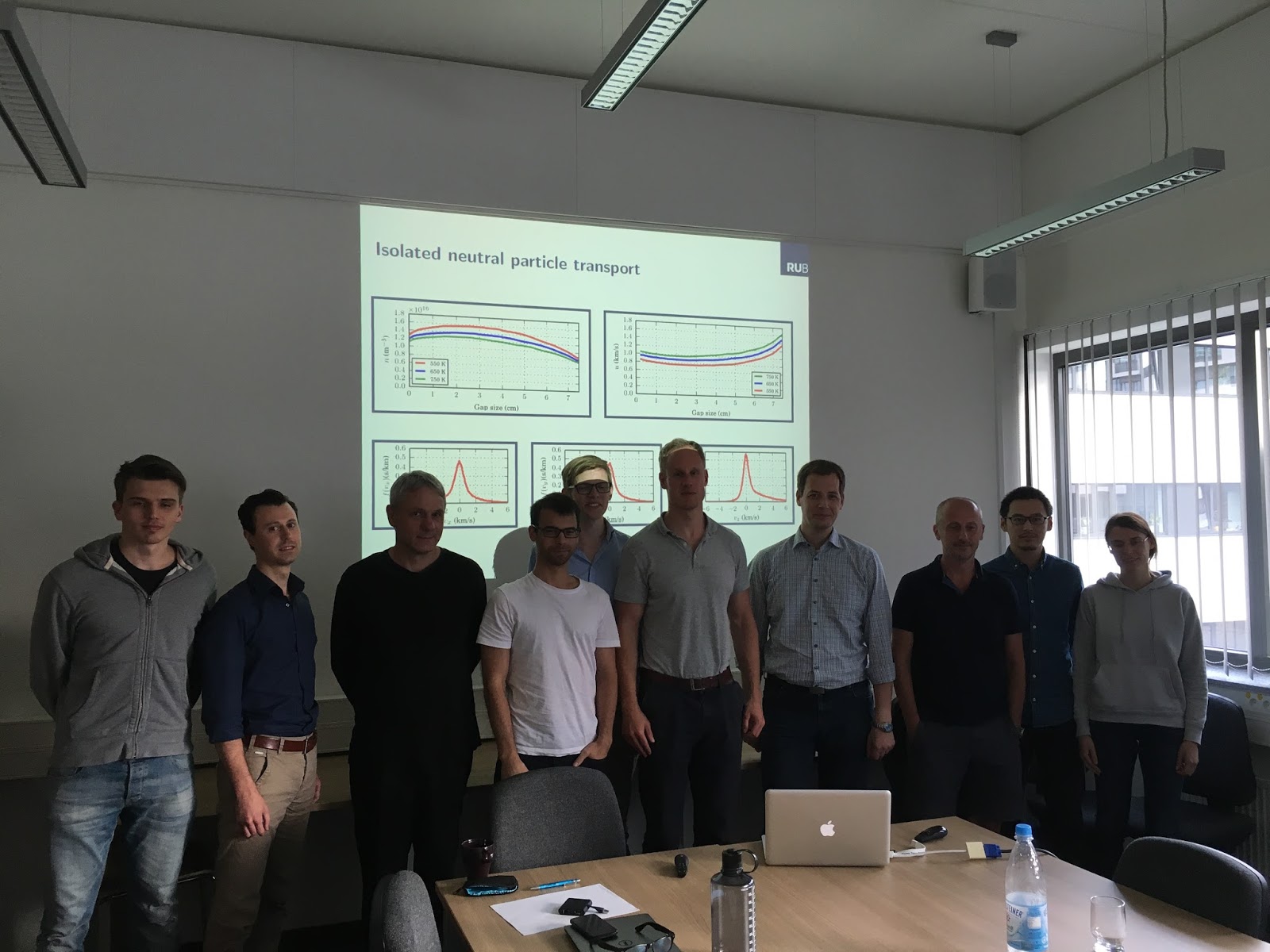 From August 8 to 9, Dr. Maik Fröhlich, head of the Plasma Surface Technology Department at the Leibniz Institute for Plasma Research and Technology e.V. (INP Greifswald), was a guest at the Chair of Theoretical Electrical Engineering at the Ruhr University Bochum as part of the IGK's Junior-Senior Program. For the purpose of scientific exchange, lectures were given and discussions were held. According to those involved, the visit and the associated discussions proved very fruitful.
EP5
PROF. DR. YI-KANG PU
From October 3 to December 17, 2016, Prof. Dr. Yi-Kang Pu from the Department of Engineering Physics, Tsinghua University, China, will join Prof. Dr. Uwe Czarnetzki, Chair of Experimental Physics V. He will give a talk on "Electron behavior in early afterglow of low pressure capacitive argon discharges" on Nov. 4 starting at 9:30 am (Room: NABF 05/694). Interested persons are welcome!
link to Yi-Kang Pu
TP4
PROF. DR. SEAN OUGHTON
From September 19 to October 14, 2016, Prof. Dr. Sean Oughton from the Department of Mathematics of The University of Waikato, New Zealand, will be a guest of PD Dr. Horst Fichtner to prepare a joint DFG project.
link to Sean Oughton
TP4
PROF. DR. YURI LITVINENKO
From December 01, 2016 to February 28, 2017, Prof. Dr. Yuri Litvinenko will again be a VIP guest of PD Dr. Horst Fichtner.
Subject: Theoretical models of cosmic-ray acceleration and transport
Abstract: The generation and transport of energetic cosmic-ray particles (electrons, protons, ions) is among the most important problems in modern astrophysics. When the particles propagate in the cosmos, they often interact with turbulent magnetic fields. The resulting complicated evolution of the cosmic-ray distribution can be mathematically described as a simpler diffusive process. The diffusion approximation and its generalisations have been employed for studying the generation and propagation of energetic particles in many astrophysical situations: in the atmosphere of the Sun, interplanetary space, and the interstellar medium.
The VIP grant will support a systematic investigation of unresolved issues of particle transport in astrophysics, with a focus on analytical and numerical modelling of diffusive particle transport. The areas of particular interest are as follows. (1) Rigorous derivation of the diffusion and telegraph approximations for cosmic-ray transport modelling, which quantifies their accuracy. (2) Development of new analytical and numerical methods for solving the equations governing the transport of solar and galactic cosmic rays. (3) Critical examination of possible mechanisms of fractional particle diffusion in the cosmos.
Foto: Copyright University of Waikato